
12 Danzas Espanolas
[Solo Guitar]
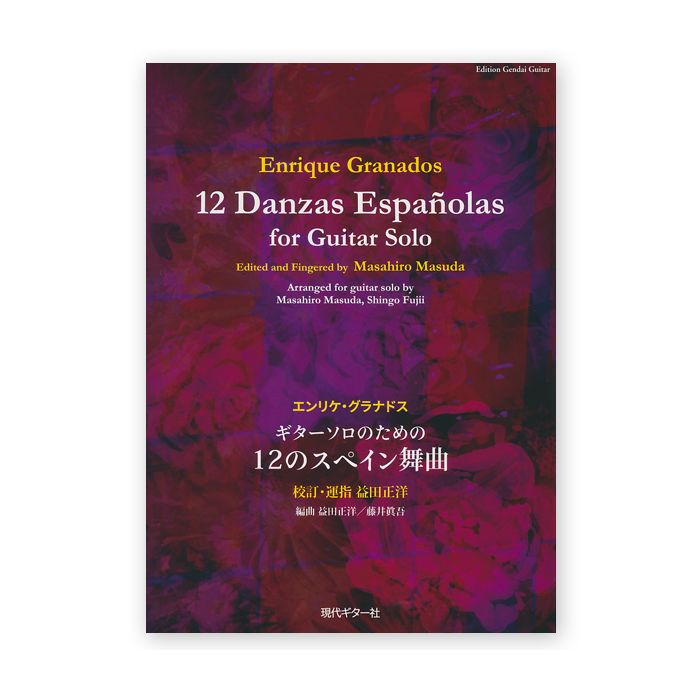
Edited and Fingered by Masahiro Masuda, Arranged for guitar solo by Masahiro Masuda, except 'No.2 Oriental' arranged by Shingo Fujii
No.1 Galante (Minueto) / No.2 Oriental* / No.3 Fandango(Zarabanda) / No.4 Villanesca / No.5 Andaluza(Playera) / No.6 Jota (Rondella Aragonesa) / No.7 Valenciana (Calesera) / No.8 Sardana(Asturiana) / No.9 Rom ntica(Mazurca) / No.10 Melanc lica(Danza Triste) / No.11 Zambra(Bolero) / No.12 Arabesca
[About the composition]
"Danzas Espanolas" is a collection of twelve pieces for piano solo. The work is divided into four books of three dances each. On hearing this work, the 19th century French composer Jules Massenet hailed Granados as "the Spanish Grieg"- we can say that these pieces made the young Granados famous. The dates of composition are not clear, but we know Granados had begun writing these pieces by the age of 20, and the first public performance took place at Teatre Liric in Barcelona in 1890. Each of the dances has the character of various Spanish dances, but it is thought that they are totally original compositions, rather than borrowing the melodies and rhythms from Spanish folk music. Additionally, the subtitles under which we know the dances today were mostly added by the publisher after the work was completed it is said that only the subtitles of no.4 (Villanesca) and no.7 (Valenciana) were approved by the composer.
[About the arrangement]
During the arrangement process, I asked myself two questions: "What if Granados originally wrote this collection of dances for the guitar?" and "What if they were transcribed by Granados himself ?"In keeping with the composer’s original intentions, I have retained the character of the original. At the same time, I took much care in not simply transferring the notes from the piano to the guitar, or compromising the musical content to make it easy to play on the guitar.I have also been careful that the notation "accurately represents the work" while also being "easy to read". As a result, there are notational differences between the guitar and piano scores. Please refer to the piano original and compare the two scores. By accurately understanding the composer’s original demands from the piano score, and then performing from this transcription, I believe it will be possible to perform the work as though it is a "work originally for guitar".As I have spent almost five years arranging and recording the work, there are differences between the recording and the printed arrangement. Please understand these differences as alterations for an "even better arrangement".It is my hope that these arrangements will be played by many guitarists as an important part of their repertoire.
| Featured Product | No |
|---|---|
| Arranger/Editor | Masahiro Masuda & Shingo Fujii |
| Composer | GRANADOS, ENRIQUE |
| Availability | Available |
| TAB/Notation | Music Notation Only |
| Level of Difficulty | 4 |
| Description | Edited and Fingered by Masahiro Masuda, Arranged for guitar solo by Masahiro Masuda, except 'No.2 Oriental' arranged by Shingo Fujii [About the composition] |