
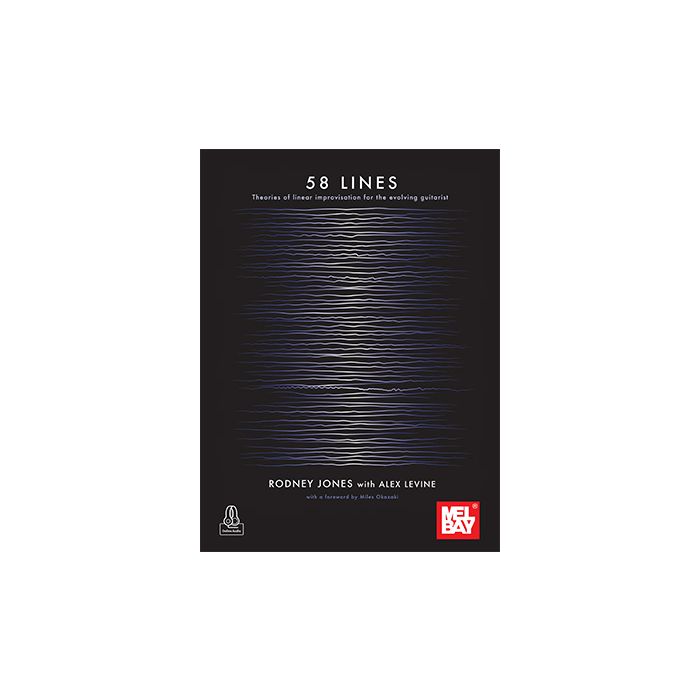
58 Lines
[Jazz Study Aid]
Theories of Linear Improvisation for the Evolving Guitarist
The Rosetta Stone is a large stone tablet (ca. 196 BCE) discovered in Egypt in 1799. It is important because it allowed researchers to translate ancient Egyptian hieroglyphic writing for the first time.
This book is a Rosetta Stone for the jazz guitarist who is ready to take a leap. Within these pages are found the tips, tools, and techniques to transform your playing and understanding of what is possible.
This book is my personal masterclass with you. Alex Levine has carefully and precisely isolated and organized 58 of the most advanced and evolutionary ideas played on the guitar. Each idea is explained, mechanics given, and the means to make it your own are offered.
This book includes audio examples of me playing each line. As a special bonus, each line is looped ten times so you can play along, learn, and absorb the information.
This book is like coming to my studio, sitting down with me, and listening as I turn decades of study, practice, and artistry into 58 lines. These lines are just for you.
Open your ears and heart and practice these lines and ideas. You will never be the same again.
Foreword by Miles Okazaki
Preface and Acknowledgments by Rodney Jones
Introduction and Acknowledgments by Alex Levine
How to Read the Fingerings
Line 1 Blues in F - Audio 2 & 3 - shifting while retaining shape, covering range
Line 2 Blues in F - Audio 4 & 5 - nine-note figure, reorienting figures, V-I idea
Line 3 Blues in F - Audio 6 & 7 - two notes per string, interlocking triads, pivot points
Line 4 Blues in F - Audio 8 & 9 - picking exercises, moveable cells
Line 5 Blues Minor - Audio 10 & 11 - descending chromatics, chromatic enclosure, Miles chromatics
Line 6 G Minor Blues - Audio 12 & 13 - fourths/fifths cells, triads in whole tones
Line 7 Darn That Dream - Audio 14 & 15 - seven-note and five-note figures, legato chromatics
Line 8 A Minor Vamp - Audio 16 & 17 - connecting chromatics, arpeggios, and scalar fragments
Line 9 Blues in F - Audio 18 & 19 - using only first and third fingers, using familiar shapes to get different combinations
Line 10 G Minor Blues - Audio 20 & 21 - shifting mid-idea, using the physical framework of cells, phrase length variation, conversation
Line 11 Impressions - Audio 22 & 23 - arpeggios in four and five-note groupings, departing/returning to home tonality, identifying cells and phrases
Line 12 It Could Happen To You - Audio 24 & 25 - chord voicings as physical frames and moveable figures, ii-V-i idea, arpeggios applied on different chords
Line 13 Jeannine - Audio 26 & 27 - minor seventh arpeggio using fingers one and four, structure of arpeggios
Line 14 Lover Man - Audio 28 & 29 - chromatic approach notes and enclosures, ghost notes
Line 15 Blues Minor - Audio 30 & 31 - same shape played with different fingering, broken chromatics, rhythmic spacing, breath, symmetrical s9 shape
Line 16 A Night in Tunisia - Audio 32 & 33 - rhythmic groupings of five, six, and seven, descending chromatics
Line 17 Willow Weep For Me - Audio 34 & 35 - ghost notes, seven-note short/long permutations
Line 18 Giant Steps - Audio 36 & 37 - moving cells through changes, V-I phrases through changes
Line 19 Days of Wine and Roses - Audio 38 & 39 - combining bebop language with descending fourths
Line 20 Giant Steps - Audio 40 & 41 - additive rhythms, isolating and applying rhythmic phrases
Line 21 Softly, as in a Morning Sunrise - Audio 42 & 43 - exploring alternative fingerings
Line 22 Blues in F - Audio 44 & 45 - minor triads in minor thirds, three-note device falling back through the beat
Line 23 Blues in F - Audio 46 & 47 - sonic trickery, using familiar phrases in unexpected ways
Line 24 Blues in F - Audio 48 & 49 - tritone substitution, melodic figures from physical chord shapes
Line 25 D Minor Blues - Audio 50 & 51 - shifts guided by individual melodic cells
Line 26 Blues in F - Audio 52 & 53 - chromatic enclosures targeting chord tones, moving between rhythmic strata
Line 27 Vamp in Bf Minor - Audio 54 & 55 - fifths and fourths concept, Arthur Blythe
Line 28 D Minor Blues - Audio 56 & 57 - phrasing with pentatonics, changing fingers to play one note
Line 29 D Minor Blues - Audio 58 & 59 - hammer-ons and dynamics, conversational phrases
Line 30 Softly, as in a Morning Sunrise - Audio 60 & 61 - sliding, the impact of fingerings on the directionality of ideas
Line 3 Blues Minor - Audio 62 & 63 - rhythmic punctuation, grammar
Line 32 Blues Minor - Audio 64 & 65 - patterns of varying lengths, rhythmic structure
Line 33 Blues Minor - Audio 66 & 67 - dominant to tonic resolution, minor tonalities moving in different intervals
Line 34 Blues in F - Audio 68 & 69 - blues language, articulation, singing quality
Line 35 Blues in F - Audio 70 & 71 - 1235 shape and variations
Line 36 Impressions - Audio 72 & 73 - whole-tone figure
Line 37 Rhythm Changes - Audio 74 & 75 - triple feel, scalar idea filled in with chromatics, fourths as a framework for expanding ideas
Line 38 Impressions - Audio 76 & 77 - directionalism
Line 39 F Minor Blues - Audio 78 & 79 - shifting tonalities, chord on every beat
Line 40 Blues Minor - Audio 80 & 81 - C minor and Bf major triads over F minor
Line 41D Minor Vamp - Audio 82 & 83 - George Benson influence, slide/interval leap to an adjacent string
Line 42 Blues in G - Audio 84 & 85 - fundamental diatonic sequences and arpeggios, minor seventh chords a major third apart
Line 43 So What - Audio 86 & 87 - descending chromatic, shifting tonalities while keeping the same fingering
Line 44 Softly, as in a Morning Sunrise - Audio 88 & 89 - ascending C minor, descending B minor
Line 45 Softly, as in a Morning Sunrise - Audio 90 & 91 - reaching out of position for a note
Line 46 Unit 7 - Audio 92 & 93 - fourths a whole tone apart, triad permutations
Line 47 Speak Low - Audio 94 & 95 - triplets grouped in twos, ghost notes
Line 48 Lover Man - Audio 96 & 97 - G minor tetrachord, retaining the same fingering through the range, scale fragments in various note groupings
Line 49 Little Sunflower - Audio 98 & 99 - building and expanding phrases from a rhythmic idea
Line 50 Blues in F - Audio 100 & 101 - shifting, directionalism
Line 51 D Minor Blues - Audio 102 & 103 - arpeggios with different numbers of notes, changing direction, delayed resolution
Line 52 Blues Minor - Audio 104 & 105 - musical sentences, structure from shifts in position, tonality, or rhythm, melodic shapes in tritones
Line 53 Little Sunflower - Audio 106 & 107 - four-over-three, whole-tone device
Line 54 Impressions - Audio 108 & 109 - two notes per string, chromatics cells, repeated notes on different strings
Line 55 Summertime - Audio 110 & 111 - sense of direction, target points, chromatic enclosure
Line 56 Speak Low - Audio 112 & 113 - arpeggios with note groupings of five and four
Line 57 Speak Low - Audio 114 & 115 - descending chromatics into chord tones
Line 58 Blues in F - Audio 116 & 117 - three-finger technique, repeated note on the same string with different fingers
| Featured Product | Yes |
|---|---|
| Composer | Rodney Jones with Alex Levine |
| Availability | Available |
| TAB/Notation | Music Notation PLUS TAB |
| Additional Media | Online Audio |
| Description | The Rosetta Stone is a large stone tablet (ca. 196 BCE) discovered in Egypt in 1799. It is important because it allowed researchers to translate ancient Egyptian hieroglyphic writing for the first time. Foreword by Miles Okazaki Preface and Acknowledgments by Rodney Jones Introduction and Acknowledgments by Alex Levine How to Read the Fingerings Line 1 Blues in F - Audio 2 & 3 - shifting while retaining shape, covering range Line 2 Blues in F - Audio 4 & 5 - nine-note figure, reorienting figures, V-I idea Line 3 Blues in F - Audio 6 & 7 - two notes per string, interlocking triads, pivot points Line 4 Blues in F - Audio 8 & 9 - picking exercises, moveable cells Line 5 Blues Minor - Audio 10 & 11 - descending chromatics, chromatic enclosure, Miles chromatics Line 6 G Minor Blues - Audio 12 & 13 - fourths/fifths cells, triads in whole tones Line 7 Darn That Dream - Audio 14 & 15 - seven-note and five-note figures, legato chromatics Line 8 A Minor Vamp - Audio 16 & 17 - connecting chromatics, arpeggios, and scalar fragments Line 9 Blues in F - Audio 18 & 19 - using only first and third fingers, using familiar shapes to get different combinations Line 10 G Minor Blues - Audio 20 & 21 - shifting mid-idea, using the physical framework of cells, phrase length variation, conversation Line 11 Impressions - Audio 22 & 23 - arpeggios in four and five-note groupings, departing/returning to home tonality, identifying cells and phrases Line 12 It Could Happen To You - Audio 24 & 25 - chord voicings as physical frames and moveable figures, ii-V-i idea, arpeggios applied on different chords Line 13 Jeannine - Audio 26 & 27 - minor seventh arpeggio using fingers one and four, structure of arpeggios Line 14 Lover Man - Audio 28 & 29 - chromatic approach notes and enclosures, ghost notes Line 15 Blues Minor - Audio 30 & 31 - same shape played with different fingering, broken chromatics, rhythmic spacing, breath, symmetrical s9 shape Line 16 A Night in Tunisia - Audio 32 & 33 - rhythmic groupings of five, six, and seven, descending chromatics Line 17 Willow Weep For Me - Audio 34 & 35 - ghost notes, seven-note short/long permutations Line 18 Giant Steps - Audio 36 & 37 - moving cells through changes, V-I phrases through changes Line 19 Days of Wine and Roses - Audio 38 & 39 - combining bebop language with descending fourths Line 20 Giant Steps - Audio 40 & 41 - additive rhythms, isolating and applying rhythmic phrases Line 21 Softly, as in a Morning Sunrise - Audio 42 & 43 - exploring alternative fingerings Line 22 Blues in F - Audio 44 & 45 - minor triads in minor thirds, three-note device falling back through the beat Line 23 Blues in F - Audio 46 & 47 - sonic trickery, using familiar phrases in unexpected ways Line 24 Blues in F - Audio 48 & 49 - tritone substitution, melodic figures from physical chord shapes Line 25 D Minor Blues - Audio 50 & 51 - shifts guided by individual melodic cells Line 26 Blues in F - Audio 52 & 53 - chromatic enclosures targeting chord tones, moving between rhythmic strata Line 27 Vamp in Bf Minor - Audio 54 & 55 - fifths and fourths concept, Arthur Blythe Line 28 D Minor Blues - Audio 56 & 57 - phrasing with pentatonics, changing fingers to play one note Line 29 D Minor Blues - Audio 58 & 59 - hammer-ons and dynamics, conversational phrases Line 30 Softly, as in a Morning Sunrise - Audio 60 & 61 - sliding, the impact of fingerings on the directionality of ideas Line 3 Blues Minor - Audio 62 & 63 - rhythmic punctuation, grammar Line 32 Blues Minor - Audio 64 & 65 - patterns of varying lengths, rhythmic structure Line 33 Blues Minor - Audio 66 & 67 - dominant to tonic resolution, minor tonalities moving in different intervals Line 34 Blues in F - Audio 68 & 69 - blues language, articulation, singing quality Line 35 Blues in F - Audio 70 & 71 - 1235 shape and variations Line 36 Impressions - Audio 72 & 73 - whole-tone figure Line 37 Rhythm Changes - Audio 74 & 75 - triple feel, scalar idea filled in with chromatics, fourths as a framework for expanding ideas Line 38 Impressions - Audio 76 & 77 - directionalism Line 39 F Minor Blues - Audio 78 & 79 - shifting tonalities, chord on every beat Line 40 Blues Minor - Audio 80 & 81 - C minor and Bf major triads over F minor Line 41D Minor Vamp - Audio 82 & 83 - George Benson influence, slide/interval leap to an adjacent string Line 42 Blues in G - Audio 84 & 85 - fundamental diatonic sequences and arpeggios, minor seventh chords a major third apart Line 43 So What - Audio 86 & 87 - descending chromatic, shifting tonalities while keeping the same fingering Line 44 Softly, as in a Morning Sunrise - Audio 88 & 89 - ascending C minor, descending B minor Line 45 Softly, as in a Morning Sunrise - Audio 90 & 91 - reaching out of position for a note Line 46 Unit 7 - Audio 92 & 93 - fourths a whole tone apart, triad permutations Line 47 Speak Low - Audio 94 & 95 - triplets grouped in twos, ghost notes Line 48 Lover Man - Audio 96 & 97 - G minor tetrachord, retaining the same fingering through the range, scale fragments in various note groupings Line 49 Little Sunflower - Audio 98 & 99 - building and expanding phrases from a rhythmic idea Line 50 Blues in F - Audio 100 & 101 - shifting, directionalism Line 51 D Minor Blues - Audio 102 & 103 - arpeggios with different numbers of notes, changing direction, delayed resolution Line 52 Blues Minor - Audio 104 & 105 - musical sentences, structure from shifts in position, tonality, or rhythm, melodic shapes in tritones Line 53 Little Sunflower - Audio 106 & 107 - four-over-three, whole-tone device Line 54 Impressions - Audio 108 & 109 - two notes per string, chromatics cells, repeated notes on different strings Line 55 Summertime - Audio 110 & 111 - sense of direction, target points, chromatic enclosure Line 56 Speak Low - Audio 112 & 113 - arpeggios with note groupings of five and four Line 57 Speak Low - Audio 114 & 115 - descending chromatics into chord tones Line 58 Blues in F - Audio 116 & 117 - three-finger technique, repeated note on the same string with different fingers |