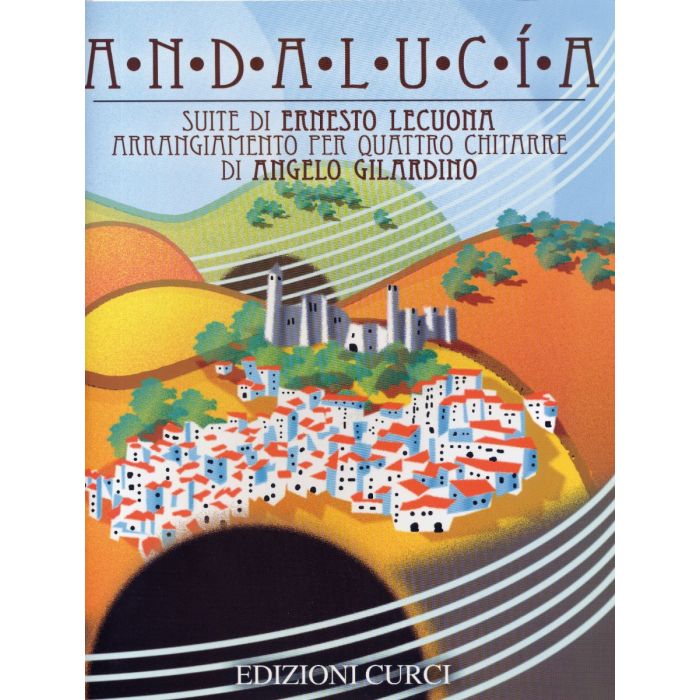
Ernesto Lecuona (Guanabacoa, Cuba, July 7, 1895 - Santa Cruz de Tenerife, November 29, 1963) is universally known as a composer of songs and operettas inspired by the Cuban popular tradition. However, he was also - especially in his youth - a brilliant pianist and composer of piano music capable of earning the praise of musicians such as Arthur Rubinstein and Maurice Ravel.
His piano suite entitled Andalucía stands in the line created by the masters of the Spanish national school between late romanticism and modernism: Isaac Albéniz and Enrique Granados. In this sense, it seemed appropriate to me to create this version for four guitars which, not being able to compete with the dynamic range and with the breadth of extension of the piano original, is nonetheless capable of realizing, within the melodic-harmonic fabric, a variety of sound planes, articulations and colors which compensates for the loss of sonic power and space.
The transcription was conceived for a quartet of guitars, three of which maintain ordinary tuning, while the fourth guitar part must be released with an instrument with at least eight strings. I have not indicated the tuning of the added strings because it will vary if, instead of an eight-string guitar, a ten-string guitar is used. This version also lends itself to being performed by larger guitar groups than the quartet, entrusting each part to two or more players. It is obvious that the director will have to dose the depths of the sonorities, avoiding redundancies.
Ernesto Lecuona (Guanabacoa, Cuba, July 7, 1895 - Santa Cruz de Tenerife, November 29, 1963) is universally known as a composer of songs and operettas inspired by the Cuban popular tradition. However, he was also - especially in his youth - a brilliant pianist and composer of piano music capable of earning the praise of musicians such as Arthur Rubinstein and Maurice Ravel.
His piano suite entitled Andalucía stands in the line created by the masters of the Spanish national school between late romanticism and modernism: Isaac Albéniz and Enrique Granados. In this sense, it seemed appropriate to me to create this version for four guitars which, not being able to compete with the dynamic range and with the breadth of extension of the piano original, is nonetheless capable of realizing, within the melodic-harmonic fabric, a variety of sound planes, articulations and colors which compensates for the loss of sonic power and space.
The transcription was conceived for a quartet of guitars, three of which maintain ordinary tuning, while the fourth guitar part must be released with an instrument with at least eight strings. I have not indicated the tuning of the added strings because it will vary if, instead of an eight-string guitar, a ten-string guitar is used. This version also lends itself to being performed by larger guitar groups than the quartet, entrusting each part to two or more players. It is obvious that the director will have to dose the depths of the sonorities, avoiding redundancies.