
Appassionata
[Solo Guitar]
SPECIAL ORDER ONLY
usually ships in 2-3 weeks
PRICE IS SUBJECT TO CHANGE
SPECIAL ORDER ONLY
usually ships in 2-3 weeks
PRICE IS SUBJECT TO CHANGE
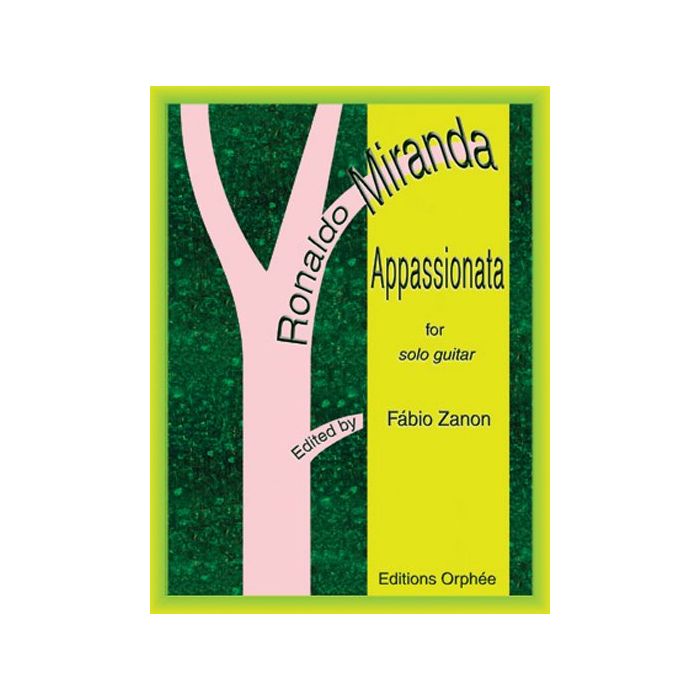
Appassionata, Ronaldo Miranda's first solo guitar work, was composed in 1984 but had to wait until 1996 for its premiere. The title, like those of several other works by Miranda, is borrowed from the historical repertoire, but there is no connection to Beethoven's sonata; it rather suggests the character, alternately pugnacious and abandoned, of a compact and vigorous sonata-form. Miranda provides the guitar repertoire with a portentous piece, largely indebted to the late-Romantic pianistic tradition, written in an instantly recognizable style of luscious harmonies and large gestures. Ronaldo Miranda was born in Rio de Janeiro in 1948 where he studied piano and Composition at the Federal University School of Music. He began his musical career as a critic for Jornal do Brasil (1974-1981) and intensified his own work as a composer after 1977, when he won the first prize at the II Biennial of Brazilian Contemporary Music. In 1978 he was selected to represent Brazil at the Unesco International Rostrum for Composers in Paris. He received in the following years several prizes in Brazilian contests for composers and also the Trofeu Golfinho de Ouro (1981) from the Government of the State of Rio de Janeiro. The Association of Art Critics of Sao Paulo regarded him as ìthe best composer of the yearî (1982) for his orchestral work Symphonic Variations, which was commissioned by the Sao Paulo Symphony Orchestra. In 1983, Ronaldo Miranda was the official delegate from Brazil at the World Music Days in ârhus (Denmark), whose international jury selected his flute trio Oriens III to be performed at the festival. In 1984, he was made ìChevalier dans lÃOrdre des Arts et des Lettersî by the Ministry of Culture (France) and, in 1985, the X Biennial of Music of Berlin chose his piano solo work Prologue, Discourse and Reflection for performance. In 1986, he had his piece Images (for clarinet and percussion) selected for the World Music Days in Budapest, participating of the event as first delegate from Brazil. He was also awarded the third prize at the International Composersà Competition (Budapest/1986) for his work Trois Moments pour Violoncelle Seul, which was premiered at the Budapest Spring Festival, in March/1987. With a grant from the Vitae Foundation, he started composing in 1988 the opera Dom Casmurro, premiered in 1992 at the Sao Paulo Municipal Theatre. Ronaldo Miranda has discreetly occupied a prominent position in the Brazilian musical scene, thanks to a constant flow of major symphonic and chamber works which denote a solid craftsmanship and a rare ability not only to pour new wine into old barrels, but also to refurbish these barrels in order to attend new demands.
| Featured Product | No |
|---|---|
| Arranger/Editor | Fabio Zanon |
| Composer | MIRANDA, RONALDO |
| Availability | Available |
| TAB/Notation | Music Notation Only |
| Description | SPECIAL ORDER ONLY
Appassionata, Ronaldo Miranda's first solo guitar work, was composed in 1984 but had to wait until 1996 for its premiere. The title, like those of several other works by Miranda, is borrowed from the historical repertoire, but there is no connection to Beethoven's sonata; it rather suggests the character, alternately pugnacious and abandoned, of a compact and vigorous sonata-form. Miranda provides the guitar repertoire with a portentous piece, largely indebted to the late-Romantic pianistic tradition, written in an instantly recognizable style of luscious harmonies and large gestures. Ronaldo Miranda was born in Rio de Janeiro in 1948 where he studied piano and Composition at the Federal University School of Music. He began his musical career as a critic for Jornal do Brasil (1974-1981) and intensified his own work as a composer after 1977, when he won the first prize at the II Biennial of Brazilian Contemporary Music. In 1978 he was selected to represent Brazil at the Unesco International Rostrum for Composers in Paris. He received in the following years several prizes in Brazilian contests for composers and also the Trofeu Golfinho de Ouro (1981) from the Government of the State of Rio de Janeiro. The Association of Art Critics of Sao Paulo regarded him as ìthe best composer of the yearî (1982) for his orchestral work Symphonic Variations, which was commissioned by the Sao Paulo Symphony Orchestra. In 1983, Ronaldo Miranda was the official delegate from Brazil at the World Music Days in ârhus (Denmark), whose international jury selected his flute trio Oriens III to be performed at the festival. In 1984, he was made ìChevalier dans lÃOrdre des Arts et des Lettersî by the Ministry of Culture (France) and, in 1985, the X Biennial of Music of Berlin chose his piano solo work Prologue, Discourse and Reflection for performance. In 1986, he had his piece Images (for clarinet and percussion) selected for the World Music Days in Budapest, participating of the event as first delegate from Brazil. He was also awarded the third prize at the International Composersà Competition (Budapest/1986) for his work Trois Moments pour Violoncelle Seul, which was premiered at the Budapest Spring Festival, in March/1987. With a grant from the Vitae Foundation, he started composing in 1988 the opera Dom Casmurro, premiered in 1992 at the Sao Paulo Municipal Theatre. Ronaldo Miranda has discreetly occupied a prominent position in the Brazilian musical scene, thanks to a constant flow of major symphonic and chamber works which denote a solid craftsmanship and a rare ability not only to pour new wine into old barrels, but also to refurbish these barrels in order to attend new demands. |