
Black is The Color
[4 Guitars] [score & parts]
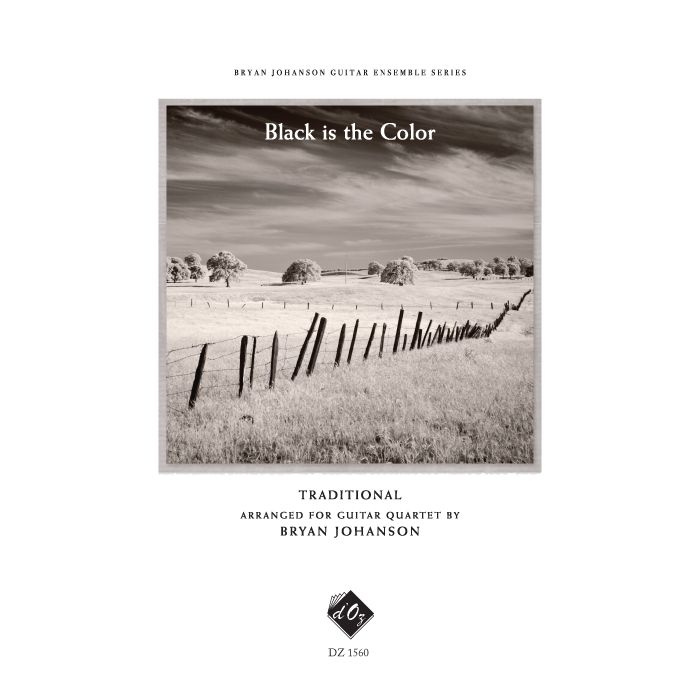
Black is the Color is a haunting American ballad that can be found in several versions. The one used here is the one I often heard my maternal grandmother sing. It remains one of my fondest and strongest childhood memories.
This is a very capable arrangement in which the four instruments do so much more than a four-part SATB harmony. The piece opens with a gentle flourishing waft of drifting arpeggios before supporting the tune - quite low down and rich - with a simple bass underneath and some harmonics on top - a delightful texture. A second verse comprises a tune in parallel octaves, some deep resonant three note arpeggios and a very effective countermelody comprising a mix of arpeggios and off-the-beat harmonies. There are one or two bars here with irregular time signatures that give the piece a dreamier, unstructured, feel. A more explosive section, with industrious runs in Guitars Three and Four, sees a more challenging rhythm up top, and the need to synchronise triplets containing dotted notes against a backdrop of semiquavers. This is where the tightness of the ensemble will be challenged. The ending is sublime - simple close harmony with shimmering chords and a wispy effect - a really rather glorious and gentle ending.
Derek Hasted (Classical Guitar Magazine)
| Featured Product | No |
|---|---|
| Arranger/Editor | Bryan Johanson |
| Composer | TRADITIONAL |
| Availability | Available |
| TAB/Notation | Music Notation Only |
| Level of Difficulty | 3 |
| Description | Black is the Color is a haunting American ballad that can be found in several versions. The one used here is the one I often heard my maternal grandmother sing. It remains one of my fondest and strongest childhood memories. This is a very capable arrangement in which the four instruments do so much more than a four-part SATB harmony. The piece opens with a gentle flourishing waft of drifting arpeggios before supporting the tune - quite low down and rich - with a simple bass underneath and some harmonics on top - a delightful texture. A second verse comprises a tune in parallel octaves, some deep resonant three note arpeggios and a very effective countermelody comprising a mix of arpeggios and off-the-beat harmonies. There are one or two bars here with irregular time signatures that give the piece a dreamier, unstructured, feel. A more explosive section, with industrious runs in Guitars Three and Four, sees a more challenging rhythm up top, and the need to synchronise triplets containing dotted notes against a backdrop of semiquavers. This is where the tightness of the ensemble will be challenged. The ending is sublime - simple close harmony with shimmering chords and a wispy effect - a really rather glorious and gentle ending. Derek Hasted (Classical Guitar Magazine) |