
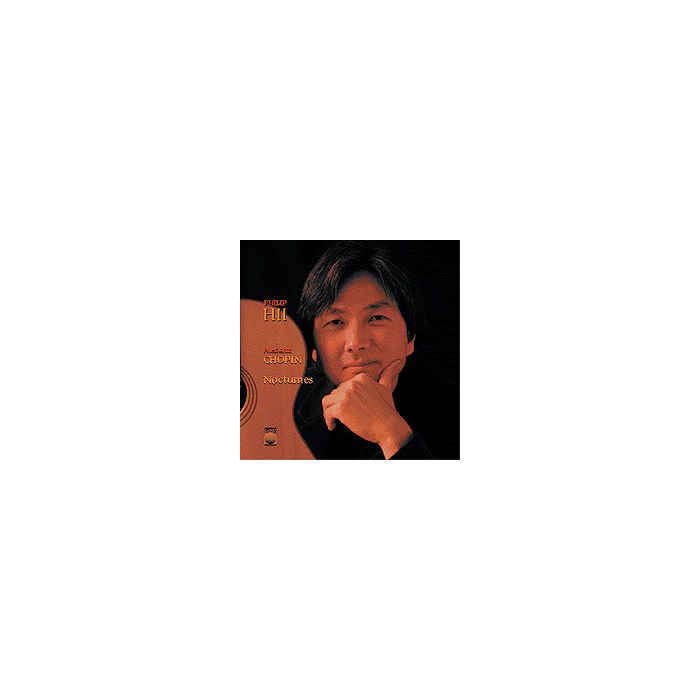
Chopin - Nocturnes
[CD]
11 Nocturnes arranged and recorded by Philip Hii
also available for downloads and streaming at: https://store.cdbaby.com/cd/philiphii - or your favorite site
"Classical guitarists have long sought a composer whom they may hail as the Chopin of the guitar. While some liken Francisco Tarrega's beautiful yet understated melodies and reflexive use of guitar idioms to Chopin's piano works, others feel more strongly that the Etudes of Heitor Villa-Lobos are to the guitar what the Chopin Etudes are to the piano. Nonetheless, the dynamic range and dazzling flourishes that mark Chopin's work have often seemed better suited to the keyboard than to the plucked string. Philip Hii's most recent release artfully defies such claims. It owes its success not only to Hii's brilliant technique, but to his inventive and studied arranging skills. The affect of the Nocturnes selected for this disc are fully maintained in Hii's guitar versions, and he navigates the delicate lines with an ease achieved only through deep thought and reflection. Op.48, No.1 is the first piece to fully explore Hii's range of talents, challenging the guitarist with quick chromatic lines interwoven into a complex polyphony. Equally memorable is Hii's performance of Op.55, No.1, in which he captures the essence of the many beautiful moments in this composition. The penultimate nocturne, Op.72, No.1, once again offers Hii the opportunity to display his acrobatics as he dances through some surprisingly fast scalar passages while carefully maintaining the active polyphonic lines. Aside from offering a wealth of new repertoire to challenge concert guitarists, this recording also sheds new light on compositions that greatly shaped the romantic period and thus I believe it would appeal to all who appreciate Chopin's work." - Timothy Smith, Minor 7th
"This uncommonly beautiful solo guitar music - 11 of Chopin's 21 Nocturnes arranged and exquisitely performed by Hii - is a gift to the spirit. Without knowing otherwise, one might think Chopin wrote for guitar rather than piano." - Chris Dodge, Utne
"Hii often puts the music first, over bravura technical display, and the result can be remarkably affecting. He has a great sense for the introverted expressive world of these pieces; and his interpretations are carefully considered, tasteful, and even moving. His scale technique is as fast as anyone's, and he plays many of these runs with a lightness of touch that few could achieve. Hii's notes offer a nice overview of Chopin's nocturnes and a persuasive defense of their transcription on the guitar." - Rings, American Record Guide
"In his all-new transcriptions of eleven 'Nocturnes', Philip Hii emerges as a forceful and engaging performer, whose penchant for surges of dynamic energy ensure no listener drifts in to a slumber, nocturnal or otherwise. ...the performances remain controlled and compelling, Hii's remarkable capacity to sustain a single-string trill against dauntingly intricate accompaniments coming into its own on several occasions." - Paul Fowles, Classical Guitar Magazine
"As Hii says in his liner notes, it's hard to imagine piano music more fit for the intimate nature of the guitar. When you stop and think about it, you ought to think that these pieces would have been standard repertory for the last century. But you would be wrong. However, listening to Hii play them, it's impossible not to be seduced.
Whereas usually getting new repertoire of late seems to mean very modern music, this is a case where you can wallow in the unabashed romanticism. Do you want music for your next rendezvous, for your wedding proposal etc. this is it without a doubt and without a touch of cheesiness. This disc is a class act all the way through, done for the love of the music rather than the marketing potential (kudos to GSP's Dean Kamei for another job well done). From the muted tones of the artwork to the warmth and depth of the recorded guitar tone, this disc is very well put together. ...it's likely that most people will recognize every single one of the pieces, even if you don't think you've heard the Nocturnes before.
So, if we've all heard these a thousand times, why should hearing them on guitar be any different? The answer is Hii's playing, as well as the sonority of the guitar. He has an exceptional feel for the romantic style, and his playing will win over the hardest of hearts. He gets inside the music, at once making you feel that he is speaking from his heart and that this music was written expressly for the guitar. His liberal use of drop D and G tunings adds a lower register that emphasizes the darkness of tone, and his decision to eschew his own editorial decisions in favor of fidelity to the piano score makes for a simple, direct musical experience.
It's so nice to have a new disc of guitar music that is so immensely listenable. Anybody would like this. It's a wonderful disc." - Tom Chandler, Rasputin Manifesto
Album Notes
Frédéric Chopin (1810-1849) wrote a total of twenty-one nocturnes, of which three were published posthumously. For various reasons, including doubts about their authenticity, two of the three posthumous nocturnes were excluded from several early editions, and many notable pianists did not record them in their complete nocturnes recordings. Happily, this situation seems to have been resolved by the publication of the new Henle Urtext edition, which includes all twenty-one works in one volume.
The word “nocturne” means “night-piece” in French. In the earlier part of the nineteenth century, the nocturne was associated with two vocal forms, one in Germany and one in Paris. The German nocturne or “notturno” was an alternative name for the serenade, while the Paris version was a new genre of love duets created by Italian composers living there at the time.
The first piano nocturne was written in 1812 by Irish pianist/composer John Field (1782-1837). Although we can only speculate as to how much Chopin’s nocturnes were influenced by the original vocal nocturnes compared to Field’s compositions, the evidence in the music seems to indicate that he was influenced by both the Parisian model and Field. There are many elements in Chopin’s nocturnes which would suggest the connection to the Paris love duet form, including the preponderance of duet melodies and the seemingly incongruous juxtaposition of love melodies and religious elements found in several of Chopin’s nocturnes (tracks 3, 6, and 11 on this CD). This echoes a stylistic feature of the Parisian nocturne which occasionally interjects religious themes in an otherwise passionate love-song setting.
Chopin’s debt to Field in his early nocturnes is also unmistakable. For instance, his Op. 9, No. 2 (track 2 on the CD) is almost a direct takeoff on Field’s first nocturne, down to the choice of the key, E-flat major. The so-called juvenilia (tracks 1, 5, and 10 on this CD) also point to Field’s influence. Chopin, however, quickly developed the form beyond its salon beginnings into a uniquely expressive vehicle culminating in the epic Nocturne in C minor, Op. 48, No. 1 (track 3 on the CD) with its thunderous octaves and agitated recitative—quite a far cry from the sweet melodies and simple recitatives which characterize many of John Field’s works in the same genre.
Despite the greater complexity of Chopin’s mature nocturnes, they remain, for the most part, texturally simple, with a clearly defined melody within a primarily homophonic environment. This trait, coupled with sparing use of pianistic devices, makes the nocturnes ideal candidates for transcription to the guitar. But perhaps my main motivation for recording the nocturnes is the sheer beauty of the melodies and their timeless quality. It is not surprising that one of the most popular piano pieces in the Romantic repertoire is Op. 9, No. 2.
Although several of the nocturnes in this album have been transcribed previously for guitar, all of the works on this recording are new transcriptions. Many of the earlier transcriptions, especially those of Tárrega and Llobet, are filled with editorial deviations from the original. Tárrega’s alterations are perhaps the most dramatic, with complete new cadenzas and other guitaristic devices in Op. 9, No. 2. My versions of the same works are more modest and attempt to follow the original piano versions more closely.
In order to optimize the limited range of the guitar and for ease of execution, key transposition is usually a part of the guitar transcription process, and these nocturnes are no exception. All the nocturnes were transposed from their original keys. Two are in G tuning (sixth string in D and fifth string in G), two are in D tuning (sixth string in D), and the rest are in regular E tuning. In addition, two of the pieces require the high C6 at fret 20. As most classical guitars stop at B5 on the 19th fret, this is slightly beyond the standard range of the guitar. I play a guitar that is customized with frets extending all the way to D6.
It has always seemed inexplicable to me that, while many of the piano works of Albéniz and Granados have been universally accepted as holding their rightful places in the guitar repertoire, much of the music of the Romantic era is declared verboten territory. The usual arguments are (1) the music of Albéniz and Granados was influenced in large part by the guitar and is therefore easily adapted to the guitar; and (2) the guitar is a “Spanish” instrument, and is best suited to repertoire that is of Spanish origin.
While the first argument may work for certain pieces in the repertoire (one can mention “Asturias” as a possible candidate in this category), it can also be argued that many of Albéniz’ and Granados’ transcribed works owe more to the Romantic salon tradition than to the Spanish guitar tradition. For instance, there is an uncanny resemblance between the opening section of Albéniz’s “Cordoba” and the “religioso” section of Chopin’s Op. 15, No.3 (track 6 on this album), not to mention his “Granada,” which one could almost mistake for a Chopin nocturne if not for the strong Latin flavor in its melody.
As to the second point, we need only mention the names of Mertz, Regondi, and Coste to understand the universal appeal of the guitar across Europe in the Romantic period and understand that, yes, the guitar is indeed eminently suited to music from Romantic composers other than those from the Iberian Peninsula.
— Philip Hii
produced and recorded by Dean Kamei at Granada Studios, El Granada, CA
mixed by Dean Kamei and Philip Hii at GSP, South San Francisco, CA
graphics and layout by GSP
photos by Allan Fontanilla
Another Philip Hii GSP CD is J.S. Bach - New Transcriptions For Guitar (GSP1012)
ABOUT PHILIP HII
Guitarist Philip Hii has performed extensively in the United States, Mexico, Germany, and New Zealand. His Bach CD received rave reviews from critics in Germany, England, Japan and the US. It was chosen as one of Guitar Player Magazine's picks of the month which says, "His passionate rubato and penetrating tone contribute to a thrilling performance." The Washington Post calls the CD "exciting" and "dazzling." and Acoustic Guitar Magazine calls him "the Heifetz of the classical guitar."
A native of Malaysia, Philip Hii started the guitar at age ten. After winning a national competition in Malaysia, he left for New Zealand to study law. Hii won the New Zealand National Cup and appeared on national television. He furthered his studies in England and Germany before coming to the United States in 1983. Philip Hii holds a B. Mus degree from Victoria University of Wellington, New Zealand as well as a jazz arranging diploma from Berklee College of Music and a Master of Music degree from the University of North Texas.
Philip Hii has published numerous articles in Soundboard, Guitar International, Gitarre und Laute, and American String Teacher and is a former Guitar Forum Editor for the AST. Six of his Bach transcriptions have been published by Guitar Solo Publications. His second CD, Stream of Consciousness, is a compilation of originals arranged for solo guitar and synthesizers. In 2004, he released his third CD, a compilation of eleven Chopin nocturnes transcribed for guitar. He is also a member of the New York City Classical Guitar Society Artistic Advisory Board. His most recent project is a series of books called The Art of Virtuosity.
also available for downloads and streaming at: https://store.cdbaby.com/cd/philiphii - or your favorite site
| Track 1 | No. 20, Op. post: lento con gran espressione |
|---|---|
| Track 2 | No. 2, Op. 9, No. 2: andante |
| Track 3 | No. 13, Op. 48, No. 1: lento |
| Track 4 | No. 5, Op. 15, No. 2: larghetto |
| Track 5 | No. 21, Op. post. |
| Track 6 | No. 6, Op. 15, No. 3: lento |
| Track 7 | No. 9, Op. 32, No. 1: andante sostenuto |
| Track 8 | No. 15, Op. 55, No. 1: andante |
| Track 9 | No. 7, Op. 27, No. 1: larghetto |
| Track 10 | No. 19, Op. post. 72, No. 1: andante |
| Track 11 | No. 11, Op. 37, No. 1: andante sostenuto |
| Featured Product | No |
| Maker/Manufacturer/Artist | HII, PHILIP |
| Availability | Available |
| Description | Album Notes Frédéric Chopin (1810-1849) wrote a total of twenty-one nocturnes, of which three were published posthumously. For various reasons, including doubts about their authenticity, two of the three posthumous nocturnes were excluded from several early editions, and many notable pianists did not record them in their complete nocturnes recordings. Happily, this situation seems to have been resolved by the publication of the new Henle Urtext edition, which includes all twenty-one works in one volume. The word “nocturne” means “night-piece” in French. In the earlier part of the nineteenth century, the nocturne was associated with two vocal forms, one in Germany and one in Paris. The German nocturne or “notturno” was an alternative name for the serenade, while the Paris version was a new genre of love duets created by Italian composers living there at the time. The first piano nocturne was written in 1812 by Irish pianist/composer John Field (1782-1837). Although we can only speculate as to how much Chopin’s nocturnes were influenced by the original vocal nocturnes compared to Field’s compositions, the evidence in the music seems to indicate that he was influenced by both the Parisian model and Field. There are many elements in Chopin’s nocturnes which would suggest the connection to the Paris love duet form, including the preponderance of duet melodies and the seemingly incongruous juxtaposition of love melodies and religious elements found in several of Chopin’s nocturnes (tracks 3, 6, and 11 on this CD). This echoes a stylistic feature of the Parisian nocturne which occasionally interjects religious themes in an otherwise passionate love-song setting. Chopin’s debt to Field in his early nocturnes is also unmistakable. For instance, his Op. 9, No. 2 (track 2 on the CD) is almost a direct takeoff on Field’s first nocturne, down to the choice of the key, E-flat major. The so-called juvenilia (tracks 1, 5, and 10 on this CD) also point to Field’s influence. Chopin, however, quickly developed the form beyond its salon beginnings into a uniquely expressive vehicle culminating in the epic Nocturne in C minor, Op. 48, No. 1 (track 3 on the CD) with its thunderous octaves and agitated recitative—quite a far cry from the sweet melodies and simple recitatives which characterize many of John Field’s works in the same genre. Despite the greater complexity of Chopin’s mature nocturnes, they remain, for the most part, texturally simple, with a clearly defined melody within a primarily homophonic environment. This trait, coupled with sparing use of pianistic devices, makes the nocturnes ideal candidates for transcription to the guitar. But perhaps my main motivation for recording the nocturnes is the sheer beauty of the melodies and their timeless quality. It is not surprising that one of the most popular piano pieces in the Romantic repertoire is Op. 9, No. 2. Although several of the nocturnes in this album have been transcribed previously for guitar, all of the works on this recording are new transcriptions. Many of the earlier transcriptions, especially those of Tárrega and Llobet, are filled with editorial deviations from the original. Tárrega’s alterations are perhaps the most dramatic, with complete new cadenzas and other guitaristic devices in Op. 9, No. 2. My versions of the same works are more modest and attempt to follow the original piano versions more closely. In order to optimize the limited range of the guitar and for ease of execution, key transposition is usually a part of the guitar transcription process, and these nocturnes are no exception. All the nocturnes were transposed from their original keys. Two are in G tuning (sixth string in D and fifth string in G), two are in D tuning (sixth string in D), and the rest are in regular E tuning. In addition, two of the pieces require the high C6 at fret 20. As most classical guitars stop at B5 on the 19th fret, this is slightly beyond the standard range of the guitar. I play a guitar that is customized with frets extending all the way to D6. It has always seemed inexplicable to me that, while many of the piano works of Albéniz and Granados have been universally accepted as holding their rightful places in the guitar repertoire, much of the music of the Romantic era is declared verboten territory. The usual arguments are (1) the music of Albéniz and Granados was influenced in large part by the guitar and is therefore easily adapted to the guitar; and (2) the guitar is a “Spanish” instrument, and is best suited to repertoire that is of Spanish origin. While the first argument may work for certain pieces in the repertoire (one can mention “Asturias” as a possible candidate in this category), it can also be argued that many of Albéniz’ and Granados’ transcribed works owe more to the Romantic salon tradition than to the Spanish guitar tradition. For instance, there is an uncanny resemblance between the opening section of Albéniz’s “Cordoba” and the “religioso” section of Chopin’s Op. 15, No.3 (track 6 on this album), not to mention his “Granada,” which one could almost mistake for a Chopin nocturne if not for the strong Latin flavor in its melody. As to the second point, we need only mention the names of Mertz, Regondi, and Coste to understand the universal appeal of the guitar across Europe in the Romantic period and understand that, yes, the guitar is indeed eminently suited to music from Romantic composers other than those from the Iberian Peninsula. — Philip Hii produced and recorded by Dean Kamei at Granada Studios, El Granada, CA
Another Philip Hii GSP CD is J.S. Bach - New Transcriptions For Guitar (GSP1012) ABOUT PHILIP HII Guitarist Philip Hii has performed extensively in the United States, Mexico, Germany, and New Zealand. His Bach CD received rave reviews from critics in Germany, England, Japan and the US. It was chosen as one of Guitar Player Magazine's picks of the month which says, "His passionate rubato and penetrating tone contribute to a thrilling performance." The Washington Post calls the CD "exciting" and "dazzling." and Acoustic Guitar Magazine calls him "the Heifetz of the classical guitar." A native of Malaysia, Philip Hii started the guitar at age ten. After winning a national competition in Malaysia, he left for New Zealand to study law. Hii won the New Zealand National Cup and appeared on national television. He furthered his studies in England and Germany before coming to the United States in 1983. Philip Hii holds a B. Mus degree from Victoria University of Wellington, New Zealand as well as a jazz arranging diploma from Berklee College of Music and a Master of Music degree from the University of North Texas. Philip Hii has published numerous articles in Soundboard, Guitar International, Gitarre und Laute, and American String Teacher and is a former Guitar Forum Editor for the AST. Six of his Bach transcriptions have been published by Guitar Solo Publications. His second CD, Stream of Consciousness, is a compilation of originals arranged for solo guitar and synthesizers. In 2004, he released his third CD, a compilation of eleven Chopin nocturnes transcribed for guitar. He is also a member of the New York City Classical Guitar Society Artistic Advisory Board. His most recent project is a series of books called The Art of Virtuosity. also available for downloads and streaming at: https://store.cdbaby.com/cd/philiphii - or your favorite site |