
Elogio de La Danza
[Solo Guitar]
with a new, optional Introduction
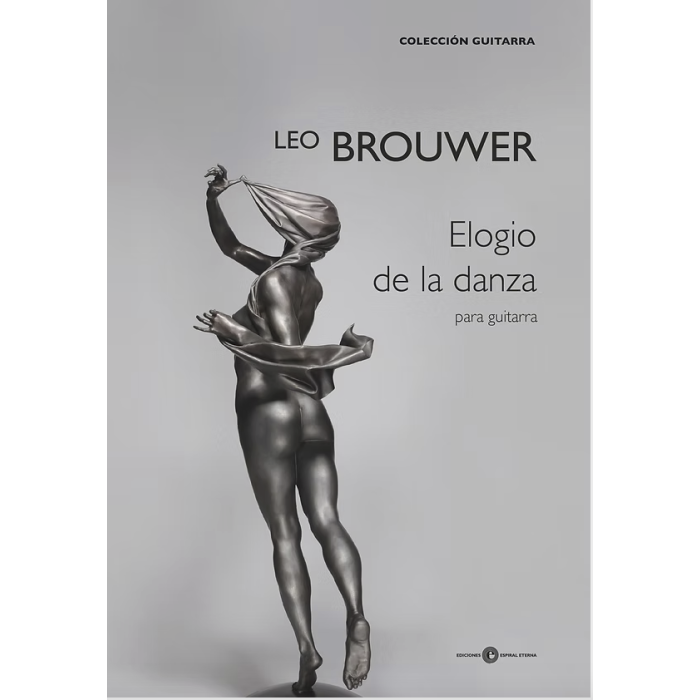
Elogio de la Danza was originally conceived in 1964 for dance at the request of choreographer Luis Trápaga. In addition to its choreography, productions such as that by Maurice Béjart filmed for Belgian television in the 1970s, in which Brouwer himself appeared performing alongside the dancers, stand out. Another notable version was Iván Tenorio's 1976 version, titled Ancestro Ibérico (Iberian Ancestor ), presented at the Varna Amphitheater in Bulgaria. In June 1991, Spanish choreographer Nacho Duato premiered Kaburías with the Spanish National Dance Company at the Itálica International Dance Festival in Seville. The title alludes to the contrast of two styles of dance, music, and theater: kabuki and flamenco (bulerías).
More than a tribute to Latin American dance—as Harold Gramatges pointed out—it is a universal tribute to dance. Its music evokes influences common to diverse cultures and, in particular, references to flamenco, perceptible in the characteristic strumming and drum beats.The work has transcended for multiple reasons: its almost perfect balance, its technical elaboration, and its ability to synthesize national popular music, Spanish tradition, and the composer's cultural background. Its impact is such that it is difficult to quantify the number of recordings made or the guitarists who have included it in their repertoire. Elogio de la Danza has become an emblematic work, almost an anthem in the world of guitar.
In 2022, to mark the work's 60th anniversary, the composer composed a new introduction for the first movement (Lento). In this edition, this introduction is included as an optional extra, allowing the guitarist to choose between playing the original 1964 introduction or this one from 2022.
| Featured Product | Yes |
|---|---|
| Composer | BROUWER, LEO |
| Availability | Available |
| TAB/Notation | Music Notation Only |
| Level of Difficulty | 4 |
| Description | Elogio de la Danza was originally conceived in 1964 for dance at the request of choreographer Luis Trápaga. In addition to its choreography, productions such as that by Maurice Béjart filmed for Belgian television in the 1970s, in which Brouwer himself appeared performing alongside the dancers, stand out. Another notable version was Iván Tenorio's 1976 version, titled Ancestro Ibérico (Iberian Ancestor ), presented at the Varna Amphitheater in Bulgaria. In June 1991, Spanish choreographer Nacho Duato premiered Kaburías with the Spanish National Dance Company at the Itálica International Dance Festival in Seville. The title alludes to the contrast of two styles of dance, music, and theater: kabuki and flamenco (bulerías). More than a tribute to Latin American dance—as Harold Gramatges pointed out—it is a universal tribute to dance. Its music evokes influences common to diverse cultures and, in particular, references to flamenco, perceptible in the characteristic strumming and drum beats.The work has transcended for multiple reasons: its almost perfect balance, its technical elaboration, and its ability to synthesize national popular music, Spanish tradition, and the composer's cultural background. Its impact is such that it is difficult to quantify the number of recordings made or the guitarists who have included it in their repertoire. Elogio de la Danza has become an emblematic work, almost an anthem in the world of guitar. |