
Five Preludes [complete set]
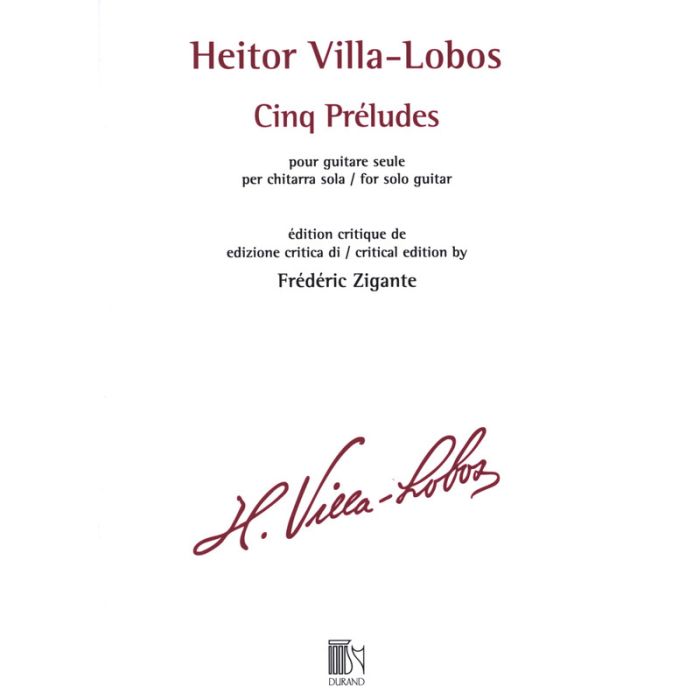
The Cinq Préludes by Heitor Villa-Lobos represent the Brazilian composer's last work for solo guitar and were written in the summer of 1940. They do not constitute a single cycle, but rather a heterogeneous collection, similar in spirit to a collection of pages from an album, with each one developing, in its own individual way, a different stylistic principle. In terms of instrumental technique, Heitor Villa-Lobos places the Préludes in a kind of ideal balance point between the still nineteenth-century writing style of the Suite populaire brésilienne and the daring instrumental experimentation of the Douze Études.
In the present edition, the manifold editorial issues concerning Heitor Villa-Lobos' guitar music have been affronted by looking at of all of the sources available today: these efforts have thus enabled us to put together a more reliable text than those before it both in terms of the notes and the fingerings.
| Featured Product | No |
|---|---|
| Arranger/Editor | Frederic Zigante |
| Composer | VILLA-LOBOS, HEITOR |
| Availability | Available |
| TAB/Notation | Music Notation Only |
| Level of Difficulty | 5 |
| Description | The Cinq Préludes by Heitor Villa-Lobos represent the Brazilian composer's last work for solo guitar and were written in the summer of 1940. They do not constitute a single cycle, but rather a heterogeneous collection, similar in spirit to a collection of pages from an album, with each one developing, in its own individual way, a different stylistic principle. In terms of instrumental technique, Heitor Villa-Lobos places the Préludes in a kind of ideal balance point between the still nineteenth-century writing style of the Suite populaire brésilienne and the daring instrumental experimentation of the Douze Études. In the present edition, the manifold editorial issues concerning Heitor Villa-Lobos' guitar music have been affronted by looking at of all of the sources available today: these efforts have thus enabled us to put together a more reliable text than those before it both in terms of the notes and the fingerings. |