
Freedom and Determinism of the Guitar - From Baroque to Avant-garde
In stock
SKU
LB46
Composer
ANDIA, RAFAEL
$25.95
[English text]
Debussy wrote to his friend Pierre Louÿs: “Above all, bring me a guitar from which will escape, when sometimes struck, like a fine dust of sound from what it once contained of barbaric melancholy.”
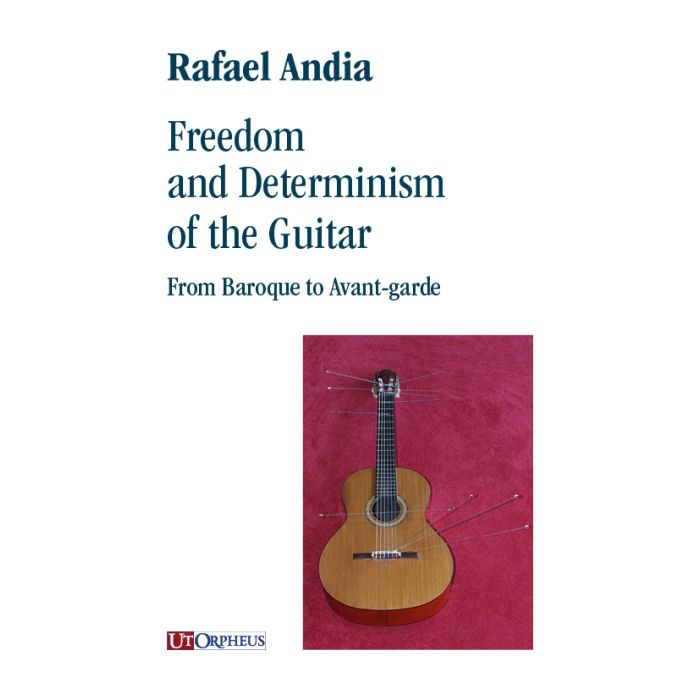
Rafael Andia proposes here a look at the techniques and writings that have created the guitar and continue to determine the very particular history of his instrument: the flamenco or classical guitar, as well as that of the twentieth century or that of the Habsburgs of 1600. The guitar dreamt of by the musicians of Impressionism or that of the Gypsies of the Tobacco Factory in Seville. He can thus weave links between the chitarra spagnuola of the Counter-Reformation and the “Spectral School” (École spectrale) of the 1970s. He reveals an instrument sometimes hesitating between a determinism imposed by other languages and the rediscovered freedom of its gestures, a guitar between submission to models and its own identity.
Rafael Andia has recorded works from Falla, Turina and Albéniz, among others, and has proposed original techniques, sometimes inherited from flamenco and oriented towards contemporary music. He has created and recorded works for solo guitar ranging from André Jolivet to Tristan Murail. He has also explored the territories of the baroque guitar within a working group at the CNRS (Centre National de la Recherche Scientifique) and has released the complete discography of Robert de Visée for Harmonia Mundi.
He has published two essays on the guitar (Libertés et déterminismes de la guitare, 2015; Labyrinthes d’un guitariste, 2016) and two novels (Rasgueados, 2018; Guitarre royalle, 2019).
| Featured Product | Yes |
|---|---|
| Composer | ANDIA, RAFAEL |
| Availability | Available |
| Description | Debussy wrote to his friend Pierre Louÿs: “Above all, bring me a guitar from which will escape, when sometimes struck, like a fine dust of sound from what it once contained of barbaric melancholy.”
Rafael Andia proposes here a look at the techniques and writings that have created the guitar and continue to determine the very particular history of his instrument: the flamenco or classical guitar, as well as that of the twentieth century or that of the Habsburgs of 1600. The guitar dreamt of by the musicians of Impressionism or that of the Gypsies of the Tobacco Factory in Seville. He can thus weave links between the chitarra spagnuola of the Counter-Reformation and the “Spectral School” (École spectrale) of the 1970s. He reveals an instrument sometimes hesitating between a determinism imposed by other languages and the rediscovered freedom of its gestures, a guitar between submission to models and its own identity.
Rafael Andia has recorded works from Falla, Turina and Albéniz, among others, and has proposed original techniques, sometimes inherited from flamenco and oriented towards contemporary music. He has created and recorded works for solo guitar ranging from André Jolivet to Tristan Murail. He has also explored the territories of the baroque guitar within a working group at the CNRS (Centre National de la Recherche Scientifique) and has released the complete discography of Robert de Visée for Harmonia Mundi.
He has published two essays on the guitar (Libertés et déterminismes de la guitare, 2015; Labyrinthes d’un guitariste, 2016) and two novels (Rasgueados, 2018; Guitarre royalle, 2019). |