
Guitar Sight-Reading 1
[Studies]
A Fresh Approach
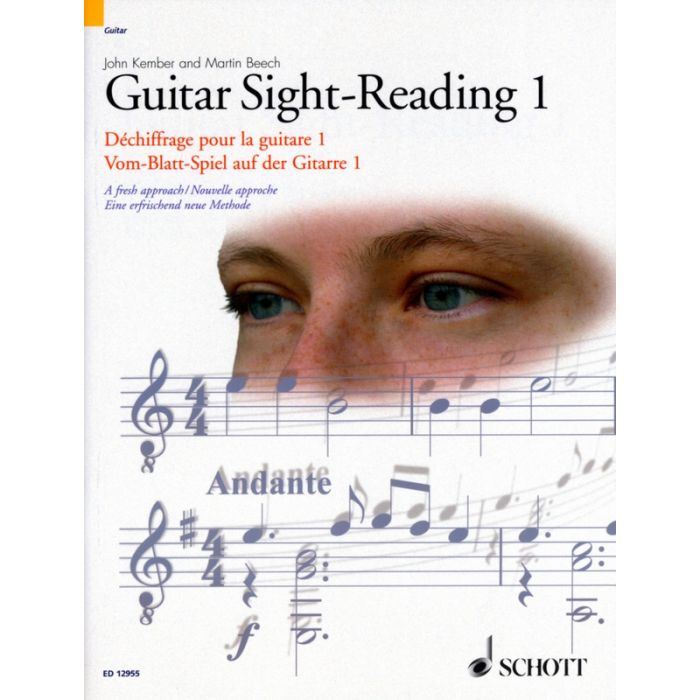
Here comes a really refreshing idea at just the right time. The two authors John Kember and Martin Beech are thorough connoisseurs of guitar didactic problems. Arranged progressively, they present a compendium of pieces that is second to none. Due to the guitar's specific application, sight-reading has traditionally been a cross for all guitar-playing generations.
By skilfully splitting the learning steps, the two succeed in creating a coherent and practical concept from easy to moderately difficult. Most important approach: all pieces without fingerings!
In combination with a textbook and accompanying selection of literature, teachers and students will certainly enjoy the exercises and pieces. Here the prospective guitarist is trained to become a mature musician! (Dieter Kreidler)
- foreword
- To the Student: Why Sight Reading?
Part 1:
- Empty treble strings
- solos
- duets
- Accompanied pieces of music
Part 2:
- Notes on the treble strings in the 1st position
- solos
- duets
- Accompanied pieces of music
Part 3:
- Notes on the treble strings and open bass strings
- solos
- duets
- Accompanied pieces of music
Part 4:
- Notes on the bass strings in the 1st position, eighth notes, dynamic indications and 2/4 time
- solos
- duets
- Accompanied pieces of music
Part 5:
- New keys, dynamic markings and expressions
- solos
- duets
- Accompanied pieces of music
Part 6:
- review; the keys F major and D minor
- solos
- duets
- Accompanied pieces of music
- glossary
| Featured Product | No |
|---|---|
| Composer | KEMBER, JOHN & BEECH, MARTIN |
| Availability | Available |
| TAB/Notation | Music Notation Only |
| Level of Difficulty | 2 |
| Description | Here comes a really refreshing idea at just the right time. The two authors John Kember and Martin Beech are thorough connoisseurs of guitar didactic problems. Arranged progressively, they present a compendium of pieces that is second to none. Due to the guitar's specific application, sight-reading has traditionally been a cross for all guitar-playing generations. By skilfully splitting the learning steps, the two succeed in creating a coherent and practical concept from easy to moderately difficult. Most important approach: all pieces without fingerings! In combination with a textbook and accompanying selection of literature, teachers and students will certainly enjoy the exercises and pieces. Here the prospective guitarist is trained to become a mature musician! (Dieter Kreidler)
Part 1:
Part 2:
Part 3:
Part 4:
Part 5:
Part 6:
|