
Irish Reel Book
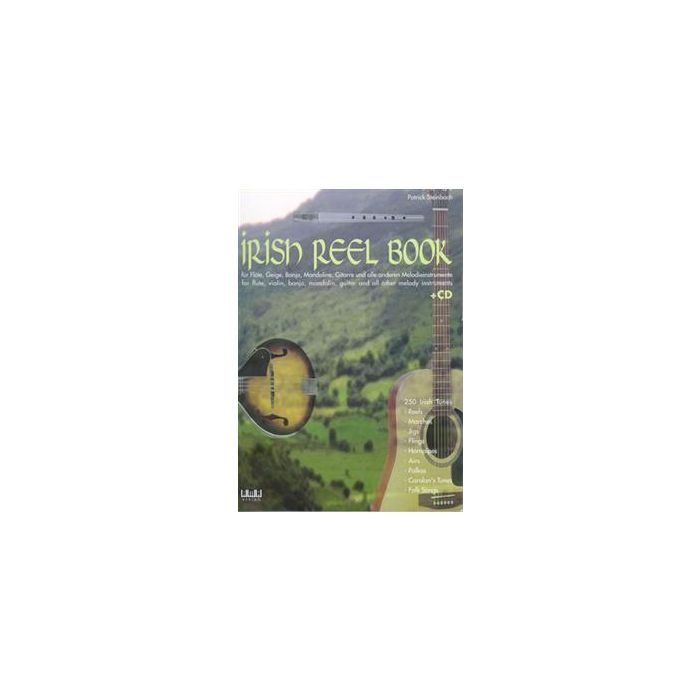
Patrick Steinbach was born in Hamburg in 1964 to an Irish mother and a German father, who was a jazz musician. He began playing guitar when he was 10 years old, later took classical guitar lessons and went on to study Music Education in Frankfurt am Main. Today, he works as a music teacher and leads many folk ensembles. Alongside the guitar, Patrick Steinbach also plays the mandolin, banjo and tin whistle. In partnership with the AMA Publishing House, he has published books which are dedicated to Irish music (‘Traditional Irish Songs’, AMA-No. 610129, and ‘Irish Songs Forever’, AMA-No. 610288). This volume, ‘Irish Real Book’, is an ultimate, yet, at the same time personal collection by the author of 250 Irish tunes like reels, jigs, flings, hornpipes, airs, polkas, marches and melodies of well-known folk songs, and harp pieces by the famous Irish harpist Turlough O’Carolan (1670-1738). The books contains many useful tips for playing in a group and arranging pieces, fingering charts for the guitar, banjo, mandolin and tin whistle, as well as compact details about Irish (musical) history. Because Irish music was mostly passed on orally and only recorded by song collectors (like Francis O’Neill, for example), the themes mainly mirror Ireland’s wartime history. As the pieces often revolved around rebellion, love, emigration, famine, heroes and saints, music was always an excuse to remember the history that the community has gone through, to make music together and to pass on the history of the country to the next generation. The melodies are almost always composed as a one-voice melody line, because the traditional, Irish music was so called ‘utility music’, which served the social aspect of entertainment, as well as getting people involved in singing and dancing together. This makes it very easy for any musician to copy and this collection is therefore suitable for all melody instruments (flute, violin, banjo, mandolin, guitar and others) and can not only be worked on by individuals, but also in an ensemble. The players have been left free reign when it comes to putting the instruments together and the group can experiment with timbre themselves. All pieces are marked with chord progressions, so that melody instruments can also be chosen to play the accompaniment. As a rule, the pieces are short tunes, which can be repeated as often as necessary for the number of instruments taking part, or else pieces in the same key or with a similar sound are combined into longer set dances (also called medleys). The lovingly recorded playback CD, with a choice of different musical styles, has made the book into a standard work of traditional Irish music.
| Featured Product | No |
|---|---|
| Arranger/Editor | Patrick Steinbach |
| Composer | VARIOUS |
| Availability | Available |
| TAB/Notation | Music Notation Only |
| Additional Media | One Audio CD |
| Description | Patrick Steinbach was born in Hamburg in 1964 to an Irish mother and a German father, who was a jazz musician. He began playing guitar when he was 10 years old, later took classical guitar lessons and went on to study Music Education in Frankfurt am Main. Today, he works as a music teacher and leads many folk ensembles. Alongside the guitar, Patrick Steinbach also plays the mandolin, banjo and tin whistle. In partnership with the AMA Publishing House, he has published books which are dedicated to Irish music (‘Traditional Irish Songs’, AMA-No. 610129, and ‘Irish Songs Forever’, AMA-No. 610288). This volume, ‘Irish Real Book’, is an ultimate, yet, at the same time personal collection by the author of 250 Irish tunes like reels, jigs, flings, hornpipes, airs, polkas, marches and melodies of well-known folk songs, and harp pieces by the famous Irish harpist Turlough O’Carolan (1670-1738). The books contains many useful tips for playing in a group and arranging pieces, fingering charts for the guitar, banjo, mandolin and tin whistle, as well as compact details about Irish (musical) history. Because Irish music was mostly passed on orally and only recorded by song collectors (like Francis O’Neill, for example), the themes mainly mirror Ireland’s wartime history. As the pieces often revolved around rebellion, love, emigration, famine, heroes and saints, music was always an excuse to remember the history that the community has gone through, to make music together and to pass on the history of the country to the next generation. The melodies are almost always composed as a one-voice melody line, because the traditional, Irish music was so called ‘utility music’, which served the social aspect of entertainment, as well as getting people involved in singing and dancing together. This makes it very easy for any musician to copy and this collection is therefore suitable for all melody instruments (flute, violin, banjo, mandolin, guitar and others) and can not only be worked on by individuals, but also in an ensemble. The players have been left free reign when it comes to putting the instruments together and the group can experiment with timbre themselves. All pieces are marked with chord progressions, so that melody instruments can also be chosen to play the accompaniment. As a rule, the pieces are short tunes, which can be repeated as often as necessary for the number of instruments taking part, or else pieces in the same key or with a similar sound are combined into longer set dances (also called medleys). The lovingly recorded playback CD, with a choice of different musical styles, has made the book into a standard work of traditional Irish music. |