
Joining The Dots, Grade 5
[Study Aid]
A Fresh Approach to Sight-Reading
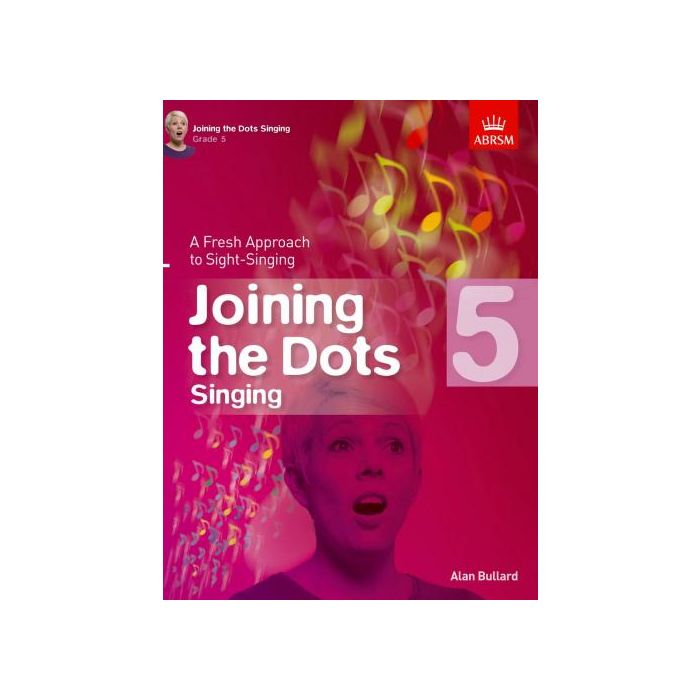
Joining the Dots Singing: Teacher’s Introduction
To the Teacher
Joining the Dots Singing offers a wealth of material to help build skill and confidence in sight-singing. Used as part of regular lessons and practice, it will help pupils learn to read new music more quickly and easily, and develop their awareness of rhythm, pitch and other general musicianship skills.
This book is designed to prepare pupils for the sightsinging section of the ABRSM Grade 1 Singing exam, but it will also help instrumentalists to develop their sight-singing skills. While every teacher will have their own approach, pupils who tackle the material in order will – with your help and with regular practice – acquire a sound sight-singing technique.
Each book in the series contains the following mix of technical and creative activities and songs to sing:
Workouts build, step by step, the rhythm and pitch skills required for the grade, and are taught both aurally and from the page. This book focuses on stepwise movement above and below the key-note. The focus of each Workout is identified in a header and then introduced in a ‘singing back’ exercise for teacher and pupil (if necessary, you could improvise more). A number of short exercises promote effective reading of staff notation using tonic sol-fa, numbered degrees of the scale or any suitable syllable.
Make Music provides an opportunity for pupils to build performing confidence in and through creative and imaginative work. Using an approach that is not primarily notation-based, the activities here will help to familiarize pupils with the ‘feel’ of a key-centre and the way that pitches relate to it, and to develop their sense of rhythm. You and your pupils can approach these exercises together in whatever way you find most comfortable, perhaps with some trial and error –experimenting is a good way to learn here!
It Takes Two enables two pupils (or pupil and teacher) to work together on the techniques learnt, and to build confidence in singing an independent part using rounds. It also offers the opportunity to practise singing with a piano accompaniment. Your pupils should take as long as necessary preparing the pieces as outlined. Plenty of time taken here, together withlots of practice, will help them to focus on the salient points in an exam sight-singing test, with its shorter preparation time.
Read and Sing provides an invaluable source of sightsinging material for those preparing for the Grade 1 Singing exam. The songs are intended to be sung at sight or after a short practice time, with the focus on keeping going. Each one has a title (unlike those in the exam), and they sometimes have a slightly wider range of colour and detail in the accompaniment, to help pupils reflect the musical mood suggested by the title. To replicate an exam scenario, encourage your pupils to set a tempo they can maintain and follow this in the accompaniment, helping to keep the song going. Some of the Read and Sing materialis also provided in the bass clef, for those who wish to develop fluency in reading both clefs. (All the treble-clef material may also be sung an octave lower.)
Songs with Words, the final page, consists of two short songs to learn. The first is a round – enabling several pupils to sing independently – and the second is a song with piano accompaniment. As these are designed to be learnt, they push the boundaries slightly while employing largely the same rhythms and intervals as the material in the rest of the book.
| Featured Product | No |
|---|---|
| Composer | BULLARD, A. & WRIGHT, R. |
| Availability | Available |
| TAB/Notation | Music Notation Only |
| Description | Joining the Dots Singing: Teacher’s Introduction To the Teacher Joining the Dots Singing offers a wealth of material to help build skill and confidence in sight-singing. Used as part of regular lessons and practice, it will help pupils learn to read new music more quickly and easily, and develop their awareness of rhythm, pitch and other general musicianship skills. This book is designed to prepare pupils for the sightsinging section of the ABRSM Grade 1 Singing exam, but it will also help instrumentalists to develop their sight-singing skills. While every teacher will have their own approach, pupils who tackle the material in order will – with your help and with regular practice – acquire a sound sight-singing technique. Each book in the series contains the following mix of technical and creative activities and songs to sing: Workouts build, step by step, the rhythm and pitch skills required for the grade, and are taught both aurally and from the page. This book focuses on stepwise movement above and below the key-note. The focus of each Workout is identified in a header and then introduced in a ‘singing back’ exercise for teacher and pupil (if necessary, you could improvise more). A number of short exercises promote effective reading of staff notation using tonic sol-fa, numbered degrees of the scale or any suitable syllable. Make Music provides an opportunity for pupils to build performing confidence in and through creative and imaginative work. Using an approach that is not primarily notation-based, the activities here will help to familiarize pupils with the ‘feel’ of a key-centre and the way that pitches relate to it, and to develop their sense of rhythm. You and your pupils can approach these exercises together in whatever way you find most comfortable, perhaps with some trial and error –experimenting is a good way to learn here! It Takes Two enables two pupils (or pupil and teacher) to work together on the techniques learnt, and to build confidence in singing an independent part using rounds. It also offers the opportunity to practise singing with a piano accompaniment. Your pupils should take as long as necessary preparing the pieces as outlined. Plenty of time taken here, together withlots of practice, will help them to focus on the salient points in an exam sight-singing test, with its shorter preparation time. Read and Sing provides an invaluable source of sightsinging material for those preparing for the Grade 1 Singing exam. The songs are intended to be sung at sight or after a short practice time, with the focus on keeping going. Each one has a title (unlike those in the exam), and they sometimes have a slightly wider range of colour and detail in the accompaniment, to help pupils reflect the musical mood suggested by the title. To replicate an exam scenario, encourage your pupils to set a tempo they can maintain and follow this in the accompaniment, helping to keep the song going. Some of the Read and Sing materialis also provided in the bass clef, for those who wish to develop fluency in reading both clefs. (All the treble-clef material may also be sung an octave lower.) Songs with Words, the final page, consists of two short songs to learn. The first is a round – enabling several pupils to sing independently – and the second is a song with piano accompaniment. As these are designed to be learnt, they push the boundaries slightly while employing largely the same rhythms and intervals as the material in the rest of the book. |