
Le Tic-Toc-Choc
[2 Guitars] [score & parts]
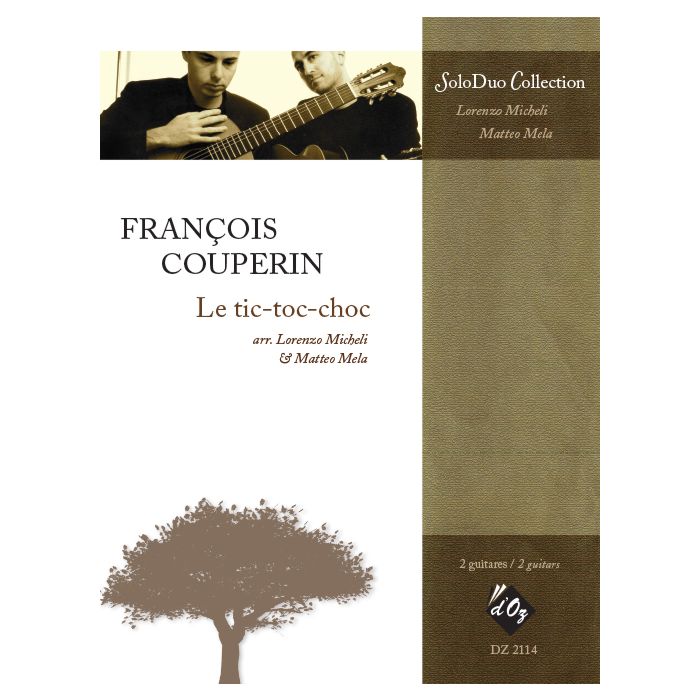
"Of all the harpsichord repertoire, one of the most remarkable pieces is Francois Couperin's Le Tic-Toc-Choc ou Les Maillotins; a 'pièce croisée' from his Dix-huitième Ordre published in his Troisième Livre of 1722. Apparently the Maillots were a famous family of rope-dancers, and the Tic-Toc perhaps refers to their repetitive movements that could be likened to an automaton, such as a clock movement. The arrangement for two guitars is constantly on the move, with a continuous stream of semiquavers in one part or the other and takes the form of a rondo with the main melody recurring four times; surrounding three couplets (marked as such) that take the form of the contrasting melodies. Like many Baroque works, it fits really well onto two guitars. Indeed the composer seemingly gave it his blessing by stating in the original 'Préface' that the work could be played on any instruments whatsoever! It does require players of considerable skill to get through the piece with the correct amount of musicality but the piece is great fun and I can imagine many duos finding this well worth investigating."
Chris Dumigan (Classical Guitar Magazine)
| Featured Product | No |
|---|---|
| Arranger/Editor | Lorenzo Micheli & Matteo Mela |
| Composer | COUPERIN, FRANCOIS |
| Availability | Available |
| TAB/Notation | Music Notation Only |
| Level of Difficulty | 3 |
| Description | "Of all the harpsichord repertoire, one of the most remarkable pieces is Francois Couperin's Le Tic-Toc-Choc ou Les Maillotins; a 'pièce croisée' from his Dix-huitième Ordre published in his Troisième Livre of 1722. Apparently the Maillots were a famous family of rope-dancers, and the Tic-Toc perhaps refers to their repetitive movements that could be likened to an automaton, such as a clock movement. The arrangement for two guitars is constantly on the move, with a continuous stream of semiquavers in one part or the other and takes the form of a rondo with the main melody recurring four times; surrounding three couplets (marked as such) that take the form of the contrasting melodies. Like many Baroque works, it fits really well onto two guitars. Indeed the composer seemingly gave it his blessing by stating in the original 'Préface' that the work could be played on any instruments whatsoever! It does require players of considerable skill to get through the piece with the correct amount of musicality but the piece is great fun and I can imagine many duos finding this well worth investigating." Chris Dumigan (Classical Guitar Magazine) |