
Maracasalsa
[4 Guitars] [score & parts]
I. Toccata
II. Fugue
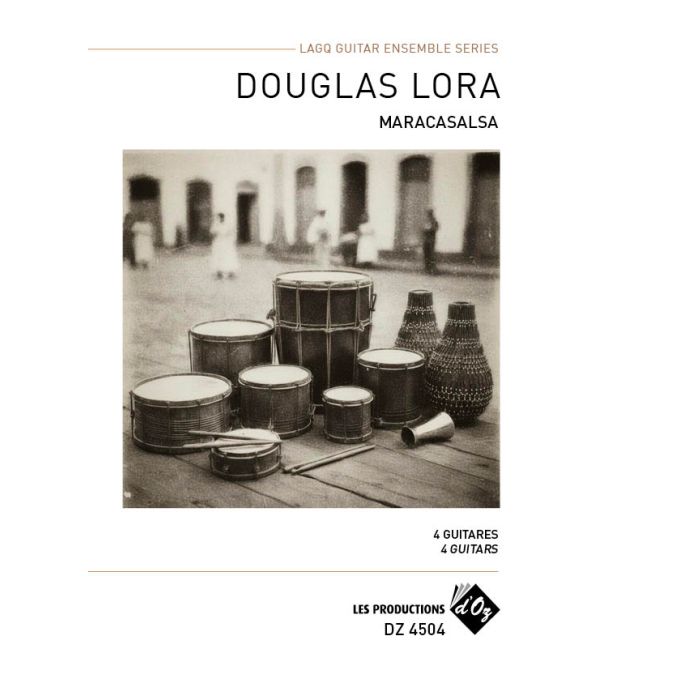
The Maracatu is a traditional rhythm from the state of Pernambuco, in the Northeast of Brazil, originating from the cultural practices of African slaves in the senzalas (slave quarters). It is deeply connected to the historical processions of the coronation of the Kings of Congo, a ceremonial tradition rich in symbolism, mythical figures, dances, songs, performances, and a diverse array of percussion instruments. One of the oldest cultural traditions in Brazil, the Maracatu was first documented at the end of the 17th century.
Its complex rhythmic characteristic results from short rhythmic motives played simultaneously, which are distributed among the percussion instruments. I employ these motives to build the themes of both movements, Toccata and Fugue. All melodies are based on these rhythmic divisions. This piece was commissioned by the Brazilian guitar quartet Quaternaglia, and it was my first experiment, as a composer, in mixing popular music from Brazil with traditional Western compositional procedures, such as the Fugue. The Salsa in the title is a play on words, representing the great melting pot that characterizes Brazilian culture.
| Featured Product | Yes |
|---|---|
| Composer | LARA, DOUGLAS |
| Availability | Available |
| TAB/Notation | Music Notation Only |
| Level of Difficulty | 4 |
| Description | The Maracatu is a traditional rhythm from the state of Pernambuco, in the Northeast of Brazil, originating from the cultural practices of African slaves in the senzalas (slave quarters). It is deeply connected to the historical processions of the coronation of the Kings of Congo, a ceremonial tradition rich in symbolism, mythical figures, dances, songs, performances, and a diverse array of percussion instruments. One of the oldest cultural traditions in Brazil, the Maracatu was first documented at the end of the 17th century. Its complex rhythmic characteristic results from short rhythmic motives played simultaneously, which are distributed among the percussion instruments. I employ these motives to build the themes of both movements, Toccata and Fugue. All melodies are based on these rhythmic divisions. This piece was commissioned by the Brazilian guitar quartet Quaternaglia, and it was my first experiment, as a composer, in mixing popular music from Brazil with traditional Western compositional procedures, such as the Fugue. The Salsa in the title is a play on words, representing the great melting pot that characterizes Brazilian culture. |