
Musings
[CD]
also available for downloads and streaming at: https://store.cdbaby.com/cd/duoerato - or your favorite site
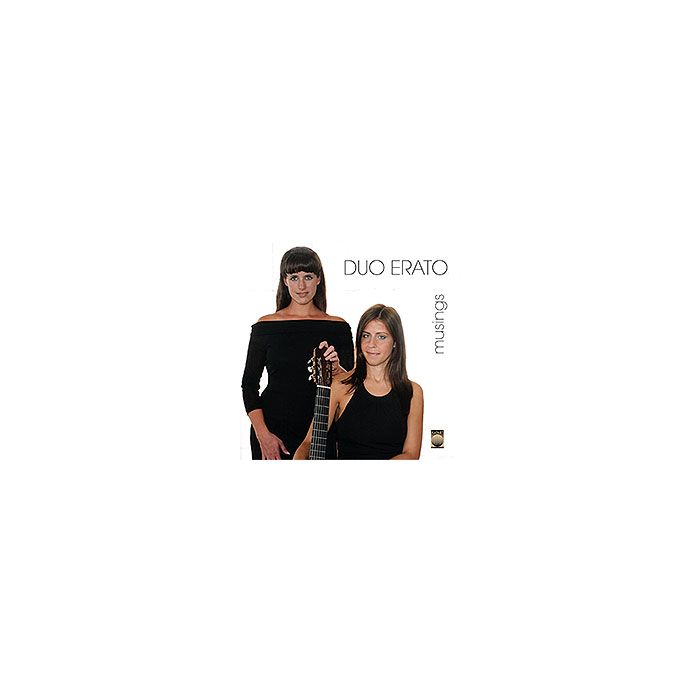
"If gentle elegance is the foam on your cappuccino, this debut CD by classical guitar duo Risa Carlson and Martha Masters is for you. The interplay of the two guitars is seamless. This CD is a worthy addition to any serious guitarist's collection, and makes a good listen for an evening by the fire." - Wendy Joseph, Victory Review
"This is their first recording and it is a fine one. They play with extraordinarry precision of ensemble and with an interpretive sophistication and refinement that reminds me of Master's solo playing. The production is first rate... a very natural guitar sound." - Rings, American Record Guide
"...together they (Risa Carlson and Martha Masters) make a most impressive duo; their phrasing, tight ensemble and first-rate mujsicianship shines through the whole of this recording making for a most pleasurable hour's listening. 'Musings' is a most satisfying CD from every aspect: playing, musicality, programming and recording quality. Recommended." - Steve Marsh, Classical Guitar Magazine
"This recording is nothing less than stunning. It is a recital of singular presentation achieved through gifted ensemble skills that are present through every moment of its run time. One's money and time are well spent here. ...as the program began I became hooked, lulled, coaxed, soothed, and enticed into a musing state, quite happily. ...a guitar duet album that will be savored for years and years to come. Bravo. Bravo." - Daniel Sturm, Minnesota Guitar Society Newsletter (Guitarist)
"This is a duo poised for great music-making - two fine players with a long history of work and friendship." - Jim McCutcheon, Soundboard Magazine
"These two talented award winning guitarists perform beautifully as an ensemble. The tone from both instruments is quite lovely and complimentary, adding to the cohesion that these two friends offer in these carefully prepared and wonderfully realized performance." - John Martin, Guitart Magazine
THE LINER NOTES
Though Pierre Petit was perhaps best known as the music critic for the French magazine Le Figaro, he was also an accomplished composer, organist, writer, and pedagogue. In Petit’s Toccata, we see the convergence of several musical trends that were in vogue in the late 1950s, including elements of neo-classicism in the style of late Stravinsky and Roussel, a hint of atonality, and a couple of episodes that seem to be an homage to an earlier era of jazz. Like several of his other works of the same period, Toccata is rhythmically contagious and fundamentally melodic. With all of these seemingly opposing musical influences juxtaposed into one piece, we often refer to this eclectic work as “cartoon music.”
César Franck began his musical career as an aspiring concert pianist, and later turned towards composition. He earned a reputation as a fine church organist, composer, and teacher. Prélude, Fugue and Variation, Op. 18, masterfully transcribed by Matanya Ophee for two guitars, is one of only a relatively few works that Franck wrote for the organ. The simple and lyrical melody of the Prélude is embellished with an arpeggiated accompaniment in the Variation, and the Fugue in between uses material from the melody of the Prelude, developing the subject in a gentle and sophisticated manner. The constant struggle between major and minor throughout the work is mercifully resolved at the finish of the Variation in a breath-taking conclusion.
Johann Padowetz, also known as Ivan Padovec, was arguably the greatest 19th century Croatian guitarist and composer. After hearing Italian virtuoso Mauro Giuliani perform, Padowetz began to study the guitar at the age of 18. By 1827, he started to give concerts, and settled in Vienna, where his concerts and compositions had been enthusiastically received. His concertizing eventually waned, but he continued writing concert repertoire and didactic works for six and ten string guitar. Born extremely near-sighted, his vision steadily declined, and by 1848, Padowetz was completely blind, left to dictate his music to friends. After giving a final concert in 1871, Padowetz died in his home city of Varaždin. Like many other 19th century composers, Johann Padowetz was inspired by Paganini’s use of the Carnival of Venice, and composed this set of virtuosic variations on the famous theme.
The Spanish nationalist composer Isaac Albéniz began his musical career as a virtuoso pianist, compared to the likes of Mozart, Liszt and Rubenstein. His compositional style, shaped by Felipe Pedrell (the “father of Spanish music”) and French composers D’Indy, Dukas, and Franck, incorporates Andalusian dance rhythms, cante jondo type melodies, and guitar idioms transferred to the piano. Albéniz produced his masterpiece, Iberia, a suite of twelve piano pieces while suffering from Bright’s disease, a kidney disorder that eventually took his life. Evocación, which opens the work, is tranquil in nature, and has characteristics of the copla. El Puerto, referring to the Port of Cádiz, contains the rhythm of the zapateado.
Though Spanish-born guitarist/composer Fernando Sor was a contemporary of Beethoven, his music more closely resembles that of Haydn or Mozart in both form and style. Traditionalism, simplicity and elegance pervade his works, including some of the most important studies ever written for the instrument. L’Encouragement, Op. 34, originally published around 1828, is one of the most popular duos in the repertoire. Dedicated to one of his lady pupils as a didactic work, the first guitar originally had only a single melody line for “l’élève” (the pupil), and the second guitar part, consisting mostly of chords was for “le maître” (the teacher). In the 1870’s Napoléon Coste rearranged the work so that both parts have a turn at the melody. We enjoy playing the Coste version for its democratic nature.
Ernesto Cordero’s Sonatina Tropical is typical of the composer’s unique style, combining Caribbean themes and harmonies with added dissonances and more complex formal structures. The first two movements of Sonatina Tropical (which were originally composed in 1981 as a set) are short sketches of diverse sentiments. The final movement, added later to complete the work, is a longer, highly developed version of a popular salsa theme, heard commonly throughout the region. The title of the last movement refers to a memorable evening of dancing salsa in a charming neighborhood in San Juan called Piñones.
Bernardo Pasquini was perhaps the most prominent virtuoso keyboardist between the times of Frescobaldi and Domenico Scarlatti. He was a prolific composer, working for a number of years as a church organist, and later as a court musician. A large portion of Pasquini’s output was for keyboard, including 28 sonatas written only in figured bass, half of which are for two keyboards. The fourteen sonatas for two keyboards are all in three movements, fast-slow-fast, as in this Sonata. This highly imitative work transfers well to guitar duo, requiring delicate balance in ensemble as the parts weave in and out at a rapid pace in the outer movements. The slow and lyrical inner movement also utilizes much back and forth between the parts, making this another highly egalitarian work in transcription.
Risa Carlson and Martha Masters
Producer: Kate Lewis
Engineer: Ryan Ayers
Editing/Mastering: Phil Calvert
Recorded at Loyola Marymount University
Photos: Charles Masters
Graphics & Layout: GSP/dk
Additional Graphics & Color Work: Tim Hall
ABOUT DUO ERATO
In recent seasons, Duo Erato has performed across North America, being praised for their lyrical and elegant musicianship. Their evocative styles as individuals seamlessly blend into one, “so tightly coordinated that it often seemed that the two women were playing a single instrument.”
Long-time friends Risa Carlson and Martha Masters began working together as a duo while students of Manuel Barrueco at the Peabody Conservatory of Music in Baltimore. Named for the muse of lyric poetry and music, Duo Erato has continued to impress audiences and critics alike since they won first prize in the 1994 National Guitar Summer Workshop Competition for ensembles and were finalists in the 1994 Baltimore Chamber Music Awards. Today, the duo’s repertoire embraces works from all periods of the genre’s history, as well as new works and transcriptions.
In addition to sharing their passion for music as performers both in chamber music and as soloists, both women are also dedicated teachers: Risa at the Levine School of Music and Georgetown University in Washington, D.C. and Martha at Loyola Marymount University in Los Angeles.
also available for downloads and streaming at: https://store.cdbaby.com/cd/duoerato - or your favorite site
Martha Masters also has 2 solo guitar recordings with GSP. They are: Viaggio in Italia (GSP1031) and Viaje en España (GSP1034)
| Track 1 | Toccata (P. Petit) |
|---|---|
| Track 2 | Prelude (C. Franck) |
| Track 3 | Lento (C. Franck) |
| Track 4 | Fugue (C. Franck) |
| Track 5 | Variation (C. Franck) |
| Track 6 | Concert Variations ...Venice (J. Padowetz) |
| Track 7 | Evocacion (I. Albeniz) |
| Track 8 | El Puerto (I. Albeniz) |
| Track 9 | Cantabile (F. Sor) |
| Track 10 | Theme (F. Sor) |
| Track 11 | Variation 1 (F. Sor) |
| Track 12 | Variation 2 (F. Sor) |
| Track 13 | Variation 3 (F. Sor) |
| Track 14 | Valse (F. Sor) |
| Track 15 | Mi Guajirita (E. Cordero) |
| Track 16 | Cancion Azul (E. Cordero) |
| Track 17 | Salsa en Pinones (E. Cordero) |
| Track 18 | Allegro (B. Pasquini) |
| Track 19 | Adagio (B. Pasquini) |
| Track 20 | Vivace (B. Pasquini) |
| Featured Product | No |
| Maker/Manufacturer/Artist | DUO ERATO (Martha Masters & Risa Carlson) |
| Availability | Available |
| Description | THE LINER NOTES Though Pierre Petit was perhaps best known as the music critic for the French magazine Le Figaro, he was also an accomplished composer, organist, writer, and pedagogue. In Petit’s Toccata, we see the convergence of several musical trends that were in vogue in the late 1950s, including elements of neo-classicism in the style of late Stravinsky and Roussel, a hint of atonality, and a couple of episodes that seem to be an homage to an earlier era of jazz. Like several of his other works of the same period, Toccata is rhythmically contagious and fundamentally melodic. With all of these seemingly opposing musical influences juxtaposed into one piece, we often refer to this eclectic work as “cartoon music.” César Franck began his musical career as an aspiring concert pianist, and later turned towards composition. He earned a reputation as a fine church organist, composer, and teacher. Prélude, Fugue and Variation, Op. 18, masterfully transcribed by Matanya Ophee for two guitars, is one of only a relatively few works that Franck wrote for the organ. The simple and lyrical melody of the Prélude is embellished with an arpeggiated accompaniment in the Variation, and the Fugue in between uses material from the melody of the Prelude, developing the subject in a gentle and sophisticated manner. The constant struggle between major and minor throughout the work is mercifully resolved at the finish of the Variation in a breath-taking conclusion. Johann Padowetz, also known as Ivan Padovec, was arguably the greatest 19th century Croatian guitarist and composer. After hearing Italian virtuoso Mauro Giuliani perform, Padowetz began to study the guitar at the age of 18. By 1827, he started to give concerts, and settled in Vienna, where his concerts and compositions had been enthusiastically received. His concertizing eventually waned, but he continued writing concert repertoire and didactic works for six and ten string guitar. Born extremely near-sighted, his vision steadily declined, and by 1848, Padowetz was completely blind, left to dictate his music to friends. After giving a final concert in 1871, Padowetz died in his home city of Varaždin. Like many other 19th century composers, Johann Padowetz was inspired by Paganini’s use of the Carnival of Venice, and composed this set of virtuosic variations on the famous theme. The Spanish nationalist composer Isaac Albéniz began his musical career as a virtuoso pianist, compared to the likes of Mozart, Liszt and Rubenstein. His compositional style, shaped by Felipe Pedrell (the “father of Spanish music”) and French composers D’Indy, Dukas, and Franck, incorporates Andalusian dance rhythms, cante jondo type melodies, and guitar idioms transferred to the piano. Albéniz produced his masterpiece, Iberia, a suite of twelve piano pieces while suffering from Bright’s disease, a kidney disorder that eventually took his life. Evocación, which opens the work, is tranquil in nature, and has characteristics of the copla. El Puerto, referring to the Port of Cádiz, contains the rhythm of the zapateado. Though Spanish-born guitarist/composer Fernando Sor was a contemporary of Beethoven, his music more closely resembles that of Haydn or Mozart in both form and style. Traditionalism, simplicity and elegance pervade his works, including some of the most important studies ever written for the instrument. L’Encouragement, Op. 34, originally published around 1828, is one of the most popular duos in the repertoire. Dedicated to one of his lady pupils as a didactic work, the first guitar originally had only a single melody line for “l’élève” (the pupil), and the second guitar part, consisting mostly of chords was for “le maître” (the teacher). In the 1870’s Napoléon Coste rearranged the work so that both parts have a turn at the melody. We enjoy playing the Coste version for its democratic nature. Ernesto Cordero’s Sonatina Tropical is typical of the composer’s unique style, combining Caribbean themes and harmonies with added dissonances and more complex formal structures. The first two movements of Sonatina Tropical (which were originally composed in 1981 as a set) are short sketches of diverse sentiments. The final movement, added later to complete the work, is a longer, highly developed version of a popular salsa theme, heard commonly throughout the region. The title of the last movement refers to a memorable evening of dancing salsa in a charming neighborhood in San Juan called Piñones. Bernardo Pasquini was perhaps the most prominent virtuoso keyboardist between the times of Frescobaldi and Domenico Scarlatti. He was a prolific composer, working for a number of years as a church organist, and later as a court musician. A large portion of Pasquini’s output was for keyboard, including 28 sonatas written only in figured bass, half of which are for two keyboards. The fourteen sonatas for two keyboards are all in three movements, fast-slow-fast, as in this Sonata. This highly imitative work transfers well to guitar duo, requiring delicate balance in ensemble as the parts weave in and out at a rapid pace in the outer movements. The slow and lyrical inner movement also utilizes much back and forth between the parts, making this another highly egalitarian work in transcription. Risa Carlson and Martha Masters Producer: Kate Lewis
ABOUT DUO ERATO In recent seasons, Duo Erato has performed across North America, being praised for their lyrical and elegant musicianship. Their evocative styles as individuals seamlessly blend into one, “so tightly coordinated that it often seemed that the two women were playing a single instrument.” Long-time friends Risa Carlson and Martha Masters began working together as a duo while students of Manuel Barrueco at the Peabody Conservatory of Music in Baltimore. Named for the muse of lyric poetry and music, Duo Erato has continued to impress audiences and critics alike since they won first prize in the 1994 National Guitar Summer Workshop Competition for ensembles and were finalists in the 1994 Baltimore Chamber Music Awards. Today, the duo’s repertoire embraces works from all periods of the genre’s history, as well as new works and transcriptions. In addition to sharing their passion for music as performers both in chamber music and as soloists, both women are also dedicated teachers: Risa at the Levine School of Music and Georgetown University in Washington, D.C. and Martha at Loyola Marymount University in Los Angeles. also available for downloads and streaming at: https://store.cdbaby.com/cd/duoerato - or your favorite site Martha Masters also has 2 solo guitar recordings with GSP. They are: Viaggio in Italia (GSP1031) and Viaje en España (GSP1034) |