
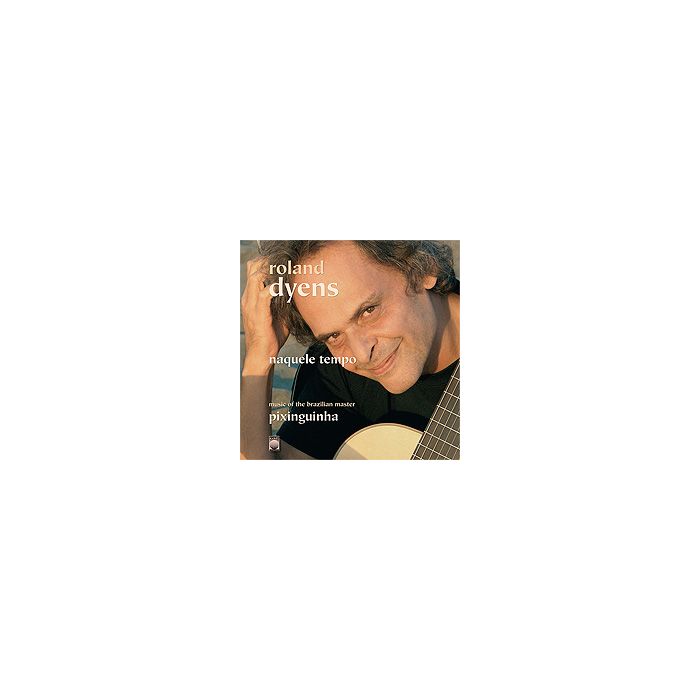
Naquele Tempo
[CD]
Music of The Brazilian Master - Pixinguinha
11 solo arrangements by Roland Dyens
Note for Note matching folio: see GSP265
Also available via download or stream at cdbaby or your favorite site
"Roland Dyens is a true artist. I will explain what I mean because in this time of self-proclaimed "artistes" where a smattering of talent is mixed with a huge dollop of hype the concept of an artist gets diluted, if not downright lost. What I mean is that Mr. Dyens is one of the finest guitarists active in any field of music, but beyond that he is one of the finest musicians we have today. Roland Dyens plays with an amazingly sensitive touch that you have to hear to understand. There is no doubt that he is one of the most expressive classical guitarists of the modern era, and he carries this deep expression into all of the styles that he has mastered.
It is important to note that Pixinguinha (real name Alfredo da Rocha Vianna, Jr.) played flute and saxophone, so for this CD Roland Dyens arranged each piece for guitar. I stress this point because they sound so natural under Mr. Dyens' fingers that you would likely think they were originally written for the guitar.
So what is the music like? Beautiful tuneful melodies with gliding Brazilian rhythms over interesting chord progressions. The CD starts off with Proezas de Solon, a lightly tripping melody over harmonies that are familiar yet have enough spice to keep you interested after several listenings. Things get livelier as the accompaniment enters into a dialogue with the melody in playful counterpoint that is dexterous but never "busy". A really fun tune.
Desprezado begins with a slower tempo and some mild dissonances that enhance its slightly mysterious, exotic aura. It soon reveals a lovely sliding melody that is joined by voices in all registers of the guitar, now in harmony, now counterpointing in inventive ways. A beautiful song and equally superb arrangement. And that ending!
Rosa begins with a soft melody in harmonics that leads into a slow ballad. Having demonstrated his prowess in counterpoint, Mr. Dyens here sets the melody with a few well-placed chords, clear harmonics, and a wonderfully sonorous lowered sixth string that gives a great anchor to the whole edifice. By now you will be extremely happy that you bought this CD!
Attencioso is a sort of choro-influenced scherzo that just flies along effortlessly. There is so much to hear - and admire - here that the song seems over far too soon. You may well be tempted to play this one again immediately.
Ingenuo begins with a simple bass melody under alternating chords. The melody moves to a higher register as the chords give way to arpeggios and counter-melodies. Roland Dyens creates yet another magic atmosphere that quite frankly is beyond words. You really have to hear this CD! I could tell you about the muffled bass counterpoint to the singing melody in the middle, but you would be better served by a single hearing.
Gargalhada begins with a "snare drum" leading into the march-like tune. (On a formal note, you might be tempted to consider this a rondo as the march theme returns between sections, but I hear it more as a "March with Trio" - if you care about this kind of thing!) The march soon gives way to a more frenetic melody that features much flashy fingerwork. The march then returns before we head into a mellower middle section. I find it incredible that such a contrast can be contained in this piece and yet it moves so logically that it is utterly convincing. The march then returns and the snare once again enters, this time to drum us out. And as with pretty much every piece, the ending is just the "piece de resistance".
Oscarina presents us with a quieter, more pensive mood. The gentle, questioning melody is presented over a fairly simple accompaniment. Soon it is answered by the bass, before resuming control of the song. There is a quality here that I find reminiscent of Mendelssohn's Songs Without Words. With a melody this lovely it is best to provide the minimal required harmony and then stay out its way, as Mr. Dyens clearly understands. It shines through the entire piece, at first fending off an "attempted tremolando" and then subsuming it into its own motion. I was quite surprised to see that this was the longest piece on the album. I found it so engrossing that time just slipped by.
Lamentos begins with an earnest melody that is mildly meditative but certainly not a lament in any overt sense. If this is a moan it is certainly a dignified one, more an acceptance than a rebellion against fate. Or you can just enjoy it as a fine piece of music.
The title piece Naquele Tempo can be heard as the heart of this whole project. Roland Dyens begins with a deeply introspective theme in an unaccompanied single line. If my limited Portuguese is correct the title means something like "in that time", and the tune definitely has a not of nostalgia to it. A simple accompaniment is added as the theme becomes more expansive. Things slowly heat up as the theme becomes more active and the accompaniment joins in with its own motion. It gradually builds to a passionate yet restrained climax, during which the theme manages to maintain its melodic integrity and even brings a measure of calm to the more driven accompaniment. Just as it seems that serenity has been attained the theme rises up to its own shattering apex which takes us to the close. What a wonderfully subtle use of form!
Things calm down again with the start of Carinhoso. This gentle melody blends with its straightforward accompaniment. I understand that Carinhoso can be translated as "loving" and this is certainly a finely crafted love song. If so, this love is not all smooth sailing, but one that manages to keep its inner beauty even in "trying" circumstances. And of course, all resolves in the end.
At first I was quite sad coming to the last song Um a Zero. However, the infectious good humor that permeates the entire piece brought me back into its irrepressible sphere of optimism. This one really motors along, and yet Mr. Dyens never loses his fine melodic sense. The accompaniment gets so complex at times that we can only marvel at his incredible sense of timing as well as his magnificent technical finesse. At the end, though, we are most struck at this gentleman's incredible musicality and we are grateful for having been given such a collection of wonderful music!
Roland Dyens is a consummate master. I would recommend any CD by him, but this one in particular has music that is fresh, different, very enjoyable, and extremely well played.
VERY HIGHLY RECOMMENDED! DO NOT MISS THIS CD!" - David Walker, www.davewalkermusic.com
"Dyens has arranged and performed these Pixinguinha classics with a master musician's deep insight and skill. There is passion on every track, particularly on the lovely "Rosa" and the haunting "Carinhosa," as well as on the more up-tempo "Desprezado." There is sheer joy and humor in "Gargalhada" which begins with Dyens's utterly convincing guitar mimicry of a snare drum. But most of all there is love. An incredibly artistic and dynamic player, Dyens caresses and shapes. He paints with subtle brush strokes and again with broad swaths of color. It is difficult to believe one is listening to the music of a single guitar and a single composer, which together transcend categorization and label." - Chip O'Brien, Minor 7th.com
"Roland Dyens is an unusual performer; he doesn't cross over between popular and classical traditions...he has mastered both.
The music has lots of variety. Gentle, nostalgic works alternate with raucous dances and virtuoso celebrations. The performances are authentic, loving, sincere...and somewhat rough. That is appropriate for this music. It doesn't need pure, genteel finish; it's music of the streets, though it can be quite complex, especially rhythmically. The roughness is another thing that makes me suspect that Dyens is improvising quite a bit...and always effectively." - Keaton, American Record Guide "Naquele Tempo is a little masterpiece. The whole thing is, as usual, perfectly recorded by Dean Kamei. Dyens confirms he is definitely one of the most refined and technically outstanding guitarists of our times." - Riccardo Rocchi, Chitarre Magazine
"A new release from Maestro Roland Dyens is always a special occasion. although dedicated and focusing on one composer this collection of pieces could arguably be a succession to Dyens's earlier landmark recordings of his arrangements of French Chanson, which have to be in the top ten guitar recordings of all time for both arranging brilliance and guitar performance.
What is fascinating is how he has put muscle and flesh to Pixinguinha's sublime music. Each piece is a foray into an exotic world of delightful modulations and swooping melodies...
One could write an essay on each piece to convey their beauty, suffice to say that Dyens has yet again raised the heights of solo guitar arrangements to skyscraper levels.
Dyens's sound has been captured beautifully on this recording. Thanks must go to producer Dean Kamei, whose projects are consistently excellent. I may sound biased but I don't think I've heard a better recording this year. An essential purchase." - Tim Panting, Classical Guitar Magazine
PIXINGUINHA (1898 - 1973)
On May 13, 1888, (25 years after slavery was abolished in the United States), while the Brazilian King was away, Princess Isabel signed the “Golden Law” which freed all slaves in Brazil without compensation to their owners. Ten years later a black Brazilian born Alfredo da Rocha Vianna, Jr. was destined to experience discrimination in both his private and professional life. His grandmother called him “Pinzindim” which is said to mean, “Good little boy.” This evolved into “Pixinguinha” (pronounced, “Pish-in-GUI-nia”).
It is hard to overstate the importance of Pixinguinha’s impact on modern music. A genius of samba and a musician’s musician, he dedicated himself to choro and never compromised his standards of excellence. He was a composer, arranger, virtuoso instrumentalist, band leader and teacher; Pixinguinha was Brazilian music.
Primarily known as a virtuoso flautist, Pixinguinha in fact recorded more on saxophone than on flute. He opted for the tenor sax in the early 1920s when they began playing in larger venues and he realized that his band, the “Oito Batutas” (Great Eight), needed a bigger sound.
Pixinguinha became the musical ambassador for Brazil. When the King and Queen of Belgium visited Brazil in 1920, the Oito Batutas played for them. Pixinguinha went on to delight the European aristocracy when the group toured there in 1922.
In 1940 the renowned conductor Leopold Stokowski asked Heitor Villa-Lobos to select a few musicians for a series of recordings that would present the best of Brazilian Popular Music. Among the first musicians Villa-Lobos contracted was a musician with sparkling original melodies — Pixinguinha.
In July, 1972 he lost his beloved wife, Albertina. On February 17th, 1973, while attending the church baptism of his grandson in Ipanema, Pixinguinha died. The next day newspapers ran this headline, “THE HEAVENS CRY!” His funeral was attended by thousands who spontaneously began singing his famous composition Carinhoso.
Pixinguinha has been called “The Cole Porter of Brazil” and he is recognized as “The Father of the Choro.” He is an icon of Brazilian music and his music is enthusiastically played today by all musicians in South America.
The word “choro” in Portuguese literally means “a cry” which probably refers to the lilting or “weeping” qualities of the solo instrument, which was usually a flute or clarinet.
When asked about the influence of Pixinguinha, he replied, “He’s a genius: a blessing and an inspiration for my life.” — Antonio Carlos Jobim
“If I had to write the whole History of Popular Brazilian Music in 15 volumes, it wouldn’t be enough at all, no question. But if I only had to write one and only word, then I would only select that one: Pixinguinha.” — the Brazilian musician and historian, Ary Vasconcelos
“The choro is definitely the most developed and sophisticated genre of all Popular Brazilian Music. There are millions of choros existing but the very best are definitely by Pixinguinha.” — the Brazilian composer, Radames Gnattali
Russ De Angelo
LOVE STORY
I was twelve years old when I first discovered popular Brazilian music. Or perhaps I was younger, I think I was actually nine years old. Or younger even, possibly four years old. Yes four years old, of course: that was when Black Orpheus came out, the cult film of the French director Marcel Camus, a contemporary of the Nouvelle Vague in cinema, of Bossa Nova in music, Oscar winner for Best Foreign Film in 1960 and of the Golden Palm at the Cannes’ Festival the year before. So I was definitely four years old when I first encountered Brazil for the very first time, and that will be the “official” date going forward. Black Orpheus! This movie whose soundtrack (especially that, without a doubt) will mark the minds of so many generations. Did you know that to this day the expression Bossa Nova remains the least inaccurate Portuguese translation of the Nouvelle Vague? The musical-film and Franco-Brazilian loop of those years could not have been closed with more panache.
It was only a little later that I made this popular Brazilian music my own, at an age, still very young — I was scarcely fourteen years old — I had the privilege to be accepted at the Ecole Normale de Musique de Paris in the class of Alberto Ponce. Back then I was leading a kind of double life: studying classical guitar “in the open” and, learning this MPB (the Brazilian abbreviation for Popular Music in Brazil) the rest of the time, almost secretly and totally self-taught. While I sight-read the set pieces at the Ecole Normale, I cleared the ground for this terra incognita that was full of promises with Baden Powell and Elis Regina LPs as my only comrades-in-arms. In short, parallel lives where Tarrega and Joao Gilberto were “great buddies” and where the old Silvius Leopold Weiss had a Love Affair with Queen Elis. It makes me smile when I think about it. It was also by deciphering the written texts on the back of records and by intoxicating myself with the song lyrics until I had an overdose that I, in fine, learned to speak Portuguese. The Portuguese of Brazil of course, this language imbued with musicality. Simply learning the basics provided me with the same jubilation as the one I felt when getting through a rebellious chord chart by Joao Gilberto or the joy I had when I imagined playing in duo with Tom Jobim on piano. Brazil! The country where everything is one. This land where the language is music and the fruits are instruments. There, even the dogs syncopate when they bark.
Right from the start this MPB began to speak to me in a very familiar and casual tone, while I, still in awe, addressed it with reverent respect. Decades later, I feel it so strongly fixed inside me, that when I say I encountered this music at the age of 4, I am afraid it’s actually a “white lie”. Okay. It’s now time for a complete confession. Here goes. I have always had the firm belief — an intimate and first-rate belief — that I encountered this MPB way before Black Orpheus. For the same reason that to this day J.S. Bach remains the only flaw in my (nevertheless) sincere atheism, Brazilian music is the “weakness” that makes me swallow the existence of previous lives. That’s it, I have said it, I have “come out”. It’s true, I was completely crazy about it.
As we all know, France, this country where I live and that I like, has some unquestionable qualities for which the whole world envies us. Besides, don’t our German neighbors, at times of happiness say: Glücklich wie Gott im Frankreich (happy as God in France)? Not so bad, all the same! Nonetheless, it is possible that these national virtues can live under the same roof — nobody’s perfect, not even France — with some minor shortcomings of…shall we call it a “cultural nature”. In the first row of these minor shortcomings I would place what I call “the self-adhesive syndrome” which can be summarized as follows, I quote: “A tendency consisting of the adhesion (preferably hasty) of a label on the forehead of all artists committing themselves to a clearly identifiable path, even for a limited time. In this case, even worse, if the latter persists in taking this same clearly identifiable path, woe betide him for his image will therefore become indelible”. End of quote. Isn’t this “self-adhesive syndrome” a little scary?
That’s why, without a doubt, for a long time — much too long when I think of it — I have guarded against the resurgence of these all-too-meaningful musical experiences, allowing only some irrepressible and possibly unconscious Brazilian shadows of the past to slip mezza voce into some of my works, no more. I would acknowledge that the great Francophile and at the same time “serious” composer of 20th century Villa-Lobos (“the white Indian of Brazil” as he used to call himself) would be my ideal alibi during these years of popular Brazilian shortage. Muito obrigado Senhor Villa-Lobos!
Time has passed and so has the concern for an image, completely. The desire and the appetite to do, on the other hand, have remained intact, even increased. And it is thanks to the three minutes of a choro by Alfredo da Rocha Vianna, Jr, played by one of the participants in an unforgettable Master Class in Lisbon in 2007 (thank you Virgilio Gomes) that I had the sudden realization, or I should say, I felt the urgency of an indispensable reunion with this music so dear to my heart. Thus this choro, trivial but luminous, awoke a whole world that was lying dormant in me for aeons. But with such a nimble eye·
And it is to this choro and this alone that I owe the idea of this arrangement project — arrangements of a minute part of a brilliant work — it is to this choro and this alone that I owe the creation of the recording that I am presenting to you here featuring the music of someone I consider as one of the greatest melody makers of all time: Alfredo da Rocha Vianna, Jr, otherwise known as Pixinguinha.
Roland Dyens — March 7, 2009
(translated by Farinaz Agharabi)
In memory of my father Robert Dyens, painter (1930-2004) and my brother Bruno Dyens, painter and designer (1969-1993)
These arrangements by Roland Dyens are available in print, exacly as recorded (GSP265) from Guitar Solo Publications: www.gspguitar.com
| Track 1 | Proezas de Solon |
|---|---|
| Track 2 | Desprezado |
| Track 3 | Rosa |
| Track 4 | Atencioso |
| Track 5 | Ingenuo |
| Track 6 | Gargalhada |
| Track 7 | Oscarina |
| Track 8 | Lamentos |
| Track 9 | Naquyele Tempo |
| Track 10 | Carinhoso |
| Track 11 | Um a Zero |
| Featured Product | No |
| Maker/Manufacturer/Artist | DYENS, ROLAND |
| Availability | Available |
| Description | PIXINGUINHA (1898 - 1973) On May 13, 1888, (25 years after slavery was abolished in the United States), while the Brazilian King was away, Princess Isabel signed the “Golden Law” which freed all slaves in Brazil without compensation to their owners. Ten years later a black Brazilian born Alfredo da Rocha Vianna, Jr. was destined to experience discrimination in both his private and professional life. His grandmother called him “Pinzindim” which is said to mean, “Good little boy.” This evolved into “Pixinguinha” (pronounced, “Pish-in-GUI-nia”). It is hard to overstate the importance of Pixinguinha’s impact on modern music. A genius of samba and a musician’s musician, he dedicated himself to choro and never compromised his standards of excellence. He was a composer, arranger, virtuoso instrumentalist, band leader and teacher; Pixinguinha was Brazilian music. Primarily known as a virtuoso flautist, Pixinguinha in fact recorded more on saxophone than on flute. He opted for the tenor sax in the early 1920s when they began playing in larger venues and he realized that his band, the “Oito Batutas” (Great Eight), needed a bigger sound. Pixinguinha became the musical ambassador for Brazil. When the King and Queen of Belgium visited Brazil in 1920, the Oito Batutas played for them. Pixinguinha went on to delight the European aristocracy when the group toured there in 1922. In 1940 the renowned conductor Leopold Stokowski asked Heitor Villa-Lobos to select a few musicians for a series of recordings that would present the best of Brazilian Popular Music. Among the first musicians Villa-Lobos contracted was a musician with sparkling original melodies — Pixinguinha. In July, 1972 he lost his beloved wife, Albertina. On February 17th, 1973, while attending the church baptism of his grandson in Ipanema, Pixinguinha died. The next day newspapers ran this headline, “THE HEAVENS CRY!” His funeral was attended by thousands who spontaneously began singing his famous composition Carinhoso. Pixinguinha has been called “The Cole Porter of Brazil” and he is recognized as “The Father of the Choro.” He is an icon of Brazilian music and his music is enthusiastically played today by all musicians in South America. The word “choro” in Portuguese literally means “a cry” which probably refers to the lilting or “weeping” qualities of the solo instrument, which was usually a flute or clarinet. When asked about the influence of Pixinguinha, he replied, “He’s a genius: a blessing and an inspiration for my life.” — Antonio Carlos Jobim “If I had to write the whole History of Popular Brazilian Music in 15 volumes, it wouldn’t be enough at all, no question. But if I only had to write one and only word, then I would only select that one: Pixinguinha.” — the Brazilian musician and historian, Ary Vasconcelos “The choro is definitely the most developed and sophisticated genre of all Popular Brazilian Music. There are millions of choros existing but the very best are definitely by Pixinguinha.” — the Brazilian composer, Radames Gnattali Russ De Angelo LOVE STORY I was twelve years old when I first discovered popular Brazilian music. Or perhaps I was younger, I think I was actually nine years old. Or younger even, possibly four years old. Yes four years old, of course: that was when Black Orpheus came out, the cult film of the French director Marcel Camus, a contemporary of the Nouvelle Vague in cinema, of Bossa Nova in music, Oscar winner for Best Foreign Film in 1960 and of the Golden Palm at the Cannes’ Festival the year before. So I was definitely four years old when I first encountered Brazil for the very first time, and that will be the “official” date going forward. Black Orpheus! This movie whose soundtrack (especially that, without a doubt) will mark the minds of so many generations. Did you know that to this day the expression Bossa Nova remains the least inaccurate Portuguese translation of the Nouvelle Vague? The musical-film and Franco-Brazilian loop of those years could not have been closed with more panache. It was only a little later that I made this popular Brazilian music my own, at an age, still very young — I was scarcely fourteen years old — I had the privilege to be accepted at the Ecole Normale de Musique de Paris in the class of Alberto Ponce. Back then I was leading a kind of double life: studying classical guitar “in the open” and, learning this MPB (the Brazilian abbreviation for Popular Music in Brazil) the rest of the time, almost secretly and totally self-taught. While I sight-read the set pieces at the Ecole Normale, I cleared the ground for this terra incognita that was full of promises with Baden Powell and Elis Regina LPs as my only comrades-in-arms. In short, parallel lives where Tarrega and Joao Gilberto were “great buddies” and where the old Silvius Leopold Weiss had a Love Affair with Queen Elis. It makes me smile when I think about it. It was also by deciphering the written texts on the back of records and by intoxicating myself with the song lyrics until I had an overdose that I, in fine, learned to speak Portuguese. The Portuguese of Brazil of course, this language imbued with musicality. Simply learning the basics provided me with the same jubilation as the one I felt when getting through a rebellious chord chart by Joao Gilberto or the joy I had when I imagined playing in duo with Tom Jobim on piano. Brazil! The country where everything is one. This land where the language is music and the fruits are instruments. There, even the dogs syncopate when they bark. Right from the start this MPB began to speak to me in a very familiar and casual tone, while I, still in awe, addressed it with reverent respect. Decades later, I feel it so strongly fixed inside me, that when I say I encountered this music at the age of 4, I am afraid it’s actually a “white lie”. Okay. It’s now time for a complete confession. Here goes. I have always had the firm belief — an intimate and first-rate belief — that I encountered this MPB way before Black Orpheus. For the same reason that to this day J.S. Bach remains the only flaw in my (nevertheless) sincere atheism, Brazilian music is the “weakness” that makes me swallow the existence of previous lives. That’s it, I have said it, I have “come out”. It’s true, I was completely crazy about it. As we all know, France, this country where I live and that I like, has some unquestionable qualities for which the whole world envies us. Besides, don’t our German neighbors, at times of happiness say: Glücklich wie Gott im Frankreich (happy as God in France)? Not so bad, all the same! Nonetheless, it is possible that these national virtues can live under the same roof — nobody’s perfect, not even France — with some minor shortcomings of…shall we call it a “cultural nature”. In the first row of these minor shortcomings I would place what I call “the self-adhesive syndrome” which can be summarized as follows, I quote: “A tendency consisting of the adhesion (preferably hasty) of a label on the forehead of all artists committing themselves to a clearly identifiable path, even for a limited time. In this case, even worse, if the latter persists in taking this same clearly identifiable path, woe betide him for his image will therefore become indelible”. End of quote. Isn’t this “self-adhesive syndrome” a little scary? That’s why, without a doubt, for a long time — much too long when I think of it — I have guarded against the resurgence of these all-too-meaningful musical experiences, allowing only some irrepressible and possibly unconscious Brazilian shadows of the past to slip mezza voce into some of my works, no more. I would acknowledge that the great Francophile and at the same time “serious” composer of 20th century Villa-Lobos (“the white Indian of Brazil” as he used to call himself) would be my ideal alibi during these years of popular Brazilian shortage. Muito obrigado Senhor Villa-Lobos! Time has passed and so has the concern for an image, completely. The desire and the appetite to do, on the other hand, have remained intact, even increased. And it is thanks to the three minutes of a choro by Alfredo da Rocha Vianna, Jr, played by one of the participants in an unforgettable Master Class in Lisbon in 2007 (thank you Virgilio Gomes) that I had the sudden realization, or I should say, I felt the urgency of an indispensable reunion with this music so dear to my heart. Thus this choro, trivial but luminous, awoke a whole world that was lying dormant in me for aeons. But with such a nimble eye· And it is to this choro and this alone that I owe the idea of this arrangement project — arrangements of a minute part of a brilliant work — it is to this choro and this alone that I owe the creation of the recording that I am presenting to you here featuring the music of someone I consider as one of the greatest melody makers of all time: Alfredo da Rocha Vianna, Jr, otherwise known as Pixinguinha. Roland Dyens — March 7, 2009
In memory of my father Robert Dyens, painter (1930-2004) and my brother Bruno Dyens, painter and designer (1969-1993) These arrangements by Roland Dyens are available in print, exacly as recorded (GSP265) from Guitar Solo Publications: www.gspguitar.com |