
Renaissance Guitar Music for Fingerstyle Ukulele
[Solo Fingerstyle Ukulele] [Book & Online Audio]
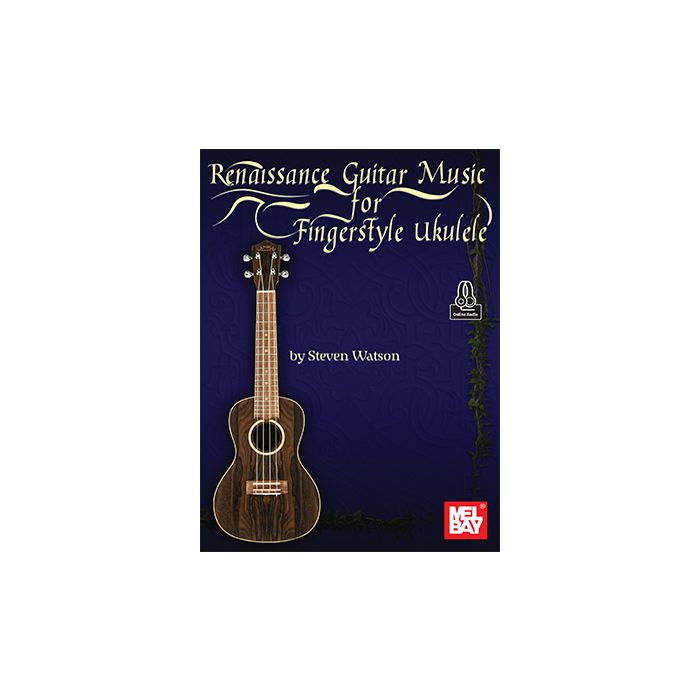
This book presents 37 pieces of Renaissance guitar music transcribed for solo fingerstyle ukulele together with the author’s recordings of every transcription. Moreover, a generous introduction provides a brief history of the Renaissance guitar, tips on period ornamentation and musicianship, recommended recordings, and invaluable resources for further research of your own.
Throughout Europe, the Renaissance guitar was a popular instrument in the middle of the sixteenth century. Its composers left us a treasure-trove of music, from rustic dances to chansons and elaborate fantasias. Five-hundred years later, this music fits beautifully on the Renaissance guitar’s musical descendant, the ukulele.
The Renaissance guitar and the ukulele share an almost identical tuning. As the transcriptions in this book are written in standard notation and tablature, any type of ukulele, from soprano to baritone—as well as the top four strings of the guitar— can be used to play them.
Most of the pieces are in standard gCEA or GCEA tuning; the seven pieces in the second section of the book, however, require low-G tuning to render the counterpoint as written. It’s also possible for guitar and baritone uke players to read the tablature provided. The music will sound a perfect 4th lower than the notation, but as there was no standard pitch in the time of the Renaissance guitar, modern players should feel no obligation to play this music at fixed pitch. If you wish to read from the tablature and sound in the same key as the notation for ensemble purposes, guitar and baritone uke players merely need to place a capo at the fifth fret. With a certain sense of historical irony, the music of the Renaissance guitar is here reborn on modern fretted instruments.
Introduction
Branle
Allemande
Branle
Quand i’entens le perdu temps
Gaillarde
Tourdion
Bransle de Poictou
Branle
Bransle Haulbaroys
Chi dira mai
Villanesque
Bransle de Poictou
Almande tournée
Vous estes la personne
Branle
Pavane
Branle de Bourgogne I
Branle de Bourgogne III
Gaillarde
Almande le Pied de cheval
Branle gay
Le Branle precedent plus diminue
Gaillarde
Gaillarde
Pimontoyse
Lo, what it is to love
Il estoit une fillette en basse-dance
Ma bouche rit
Contreclare
La Seraphine
Prélude I
Prélude II
Fantasie V
Fantasia
Fantasie III
Canon
Fantasie I
| Featured Product | Yes |
|---|---|
| Arranger/Editor | Steve Watson |
| Composer | VARIOUS |
| Availability | Available |
| TAB/Notation | Music Notation PLUS TAB |
| Level of Difficulty | 2 |
| Description | This book presents 37 pieces of Renaissance guitar music transcribed for solo fingerstyle ukulele together with the author’s recordings of every transcription. Moreover, a generous introduction provides a brief history of the Renaissance guitar, tips on period ornamentation and musicianship, recommended recordings, and invaluable resources for further research of your own. Introduction Branle Allemande Branle Quand i’entens le perdu temps Gaillarde Tourdion Bransle de Poictou Branle Bransle Haulbaroys Chi dira mai Villanesque Bransle de Poictou Almande tournée Vous estes la personne Branle Pavane Branle de Bourgogne I Branle de Bourgogne III Gaillarde Almande le Pied de cheval Branle gay Le Branle precedent plus diminue Gaillarde Gaillarde Pimontoyse Lo, what it is to love Il estoit une fillette en basse-dance Ma bouche rit Contreclare La Seraphine Prélude I Prélude II Fantasie V Fantasia Fantasie III Canon Fantasie I |