
Sandy's Portrait
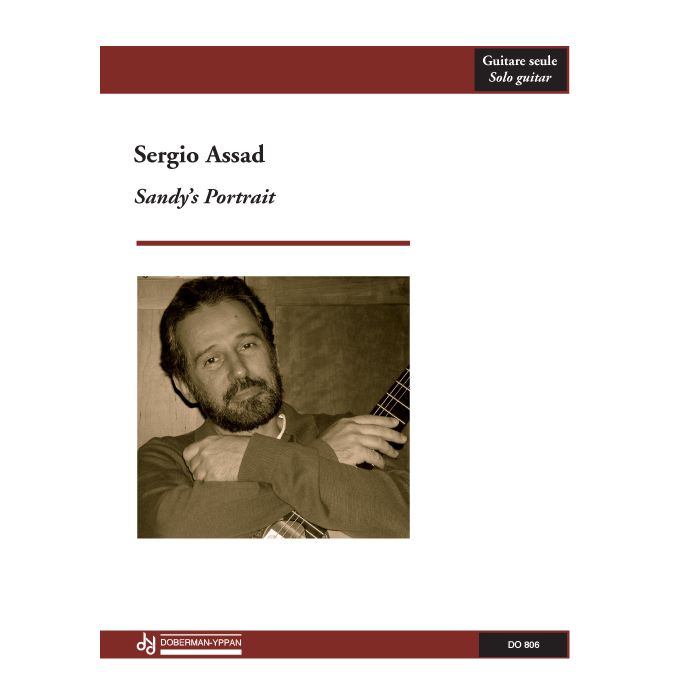
Sandy's Portrait came into being when David Russell and Thomas Patterson invited Sergio Assad to write a composition in honour Dr. Sandford "Sandy" Bolton who had created two endowments to help the University of Arizona become a major centre for aspiring guitarists. Dr. Bolton sadly died before the piece had been premiered, but this was done at a concert given by the Assad brothers to commemorate his memory. This composition could not be a more fitting tribute to someone who had loved the guitar, the work, in three movements is virtuosic, beautifully melodic and harmonically it's absolutely delectable. The writing, as one would expect from such a composer, uses the whole palate of colours available to the performer, with sharply contrasting sections the music unfolds in a natural flow with ideas which are expanded and developed to form a coherent musical structure. The three movements, Preludio-slow and reflective, Passacaglia-reflexive and Toccata; fit together to complete a superbly written, substantial composition for the guitar, I sincerely hope that Sandy's Portrait becomes a loved and much heard work in guitar recital programmes. - John Arran, Classical Guitar Magazine
Sandy's Portrait came into being when David Russell and Thomas Patterson invited Sergio Assad to write a composition in honour Dr. Sandford “Sandy” Bolton who had created two endowments to help the University of Arizona become a major centre for aspiring guitarists. Dr. Bolton sadly died before the piece had been premiered, but this was done at a concert given by the Assad brothers to commemorate his memory. This composition could not be a more fitting tribute to someone who had loved the guitar, the work, in three movements is virtuosic, beautifully melodic and harmonically it's absolutely delectable. The writing, as one would expect from such a composer, uses the whole palate of colours available to the performer, with sharply contrasting sections the music unfolds in a natural flow with ideas which are expanded and developed to form a coherent musical structure. The three movements, Preludio-slow and reflective, Passacaglia-reflexive and Toccata; fit together to complete a superbly written, substantial composition for the guitar, I sincerely hope that Sandy's Portrait becomes a loved and much heard work in guitar recital programmes.
John Arran (Classical Guitar Magazine)
As performer or composer, Sérgio Assad needs no introduction. His Sandy’s Portrait is a cyclical work in three movements: Preludio, Passacaglia, and Toccata. It was written in honor of Dr. Sanford “Sandy” Bolton, whose professional career was in science but who also loved the classical guitar. Apart from attending every guitar concert and competition held at the University of Arizona School of Music, Dr. Bolton was also involved in playing and making guitars. This evocative work was produced in 2011 and premiered just a month after Sandy passed away - in October of that year. Its genesis came about when Thomas Patterson, Director of the Bolton Guitar Studies at Arizona, together with David Russell, invited Assad to write a piece inspired by Sandy’s preference for beautiful melody and tonal harmony. Also, Sandy’s favorite musical genre was the passacaglia, a genre which first appeared in print in Spain at the end of the 16th century and underwent considerable transformation across Europe in the 17th century and beyond. Surviving into modern rimes, it here forms the central movement of Assad’s musical vignette. The thematic basis of Sandy’s Portrait derives from the musical spelling of Dr. Bolton's name: S(mi) A(la) N(sol) D(re) Y(do) / B(si) O(la) L(mi) T(fa) O(la) N(sol). This work by Assad is representative of the composer’s creative output overall: engaging, unified, and complex.
- Uros Dojcinovic (Soundboard)
| Featured Product | No |
|---|---|
| Composer | ASSAD, SERGIO |
| Availability | Available |
| TAB/Notation | Music Notation Only |
| Level of Difficulty | 4 |
| Description | Sandy's Portrait came into being when David Russell and Thomas Patterson invited Sergio Assad to write a composition in honour Dr. Sandford “Sandy” Bolton who had created two endowments to help the University of Arizona become a major centre for aspiring guitarists. Dr. Bolton sadly died before the piece had been premiered, but this was done at a concert given by the Assad brothers to commemorate his memory. This composition could not be a more fitting tribute to someone who had loved the guitar, the work, in three movements is virtuosic, beautifully melodic and harmonically it's absolutely delectable. The writing, as one would expect from such a composer, uses the whole palate of colours available to the performer, with sharply contrasting sections the music unfolds in a natural flow with ideas which are expanded and developed to form a coherent musical structure. The three movements, Preludio-slow and reflective, Passacaglia-reflexive and Toccata; fit together to complete a superbly written, substantial composition for the guitar, I sincerely hope that Sandy's Portrait becomes a loved and much heard work in guitar recital programmes. John Arran (Classical Guitar Magazine) As performer or composer, Sérgio Assad needs no introduction. His Sandy’s Portrait is a cyclical work in three movements: Preludio, Passacaglia, and Toccata. It was written in honor of Dr. Sanford “Sandy” Bolton, whose professional career was in science but who also loved the classical guitar. Apart from attending every guitar concert and competition held at the University of Arizona School of Music, Dr. Bolton was also involved in playing and making guitars. This evocative work was produced in 2011 and premiered just a month after Sandy passed away - in October of that year. Its genesis came about when Thomas Patterson, Director of the Bolton Guitar Studies at Arizona, together with David Russell, invited Assad to write a piece inspired by Sandy’s preference for beautiful melody and tonal harmony. Also, Sandy’s favorite musical genre was the passacaglia, a genre which first appeared in print in Spain at the end of the 16th century and underwent considerable transformation across Europe in the 17th century and beyond. Surviving into modern rimes, it here forms the central movement of Assad’s musical vignette. The thematic basis of Sandy’s Portrait derives from the musical spelling of Dr. Bolton's name: S(mi) A(la) N(sol) D(re) Y(do) / B(si) O(la) L(mi) T(fa) O(la) N(sol). This work by Assad is representative of the composer’s creative output overall: engaging, unified, and complex. - Uros Dojcinovic (Soundboard) |