
Sight Reading for Guitarists
[Study Aid]
SPECIAL ORDER ONLY
usually ships in 2-3 weeks
PRICE IS SUBJECT TO CHANGE
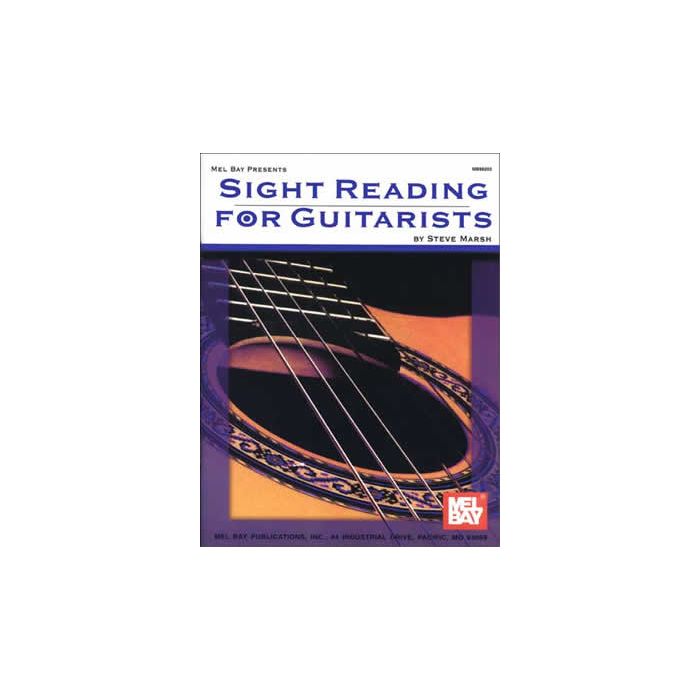
These melodies are what all sight-reading should be about but usually are not. They use easy notes and rhythms in a most methodical, imaginative and pleasurable way, concentrating on single-line melodies in first position only. This book has one hundred melodies which could be introduced to the student from almost the very first lesson, and as the melodies get progressively more complex, the book will be useful for higher-grade students. Although the book is aimed at the grade 1-2 player, more experienced students may also find it useful to try playing the studies in higher positions.
Introduction
Hints on using this book
Counting the rhythms used
in this book
Piece # 1 - # 100 are in first position with no notes higher than fret four and are single-line melodies, i.e.: no more than one note at a time is played.
Notes used in this book are whole notes, half notes, dotted half notes, quarter notes, eighth notes, and dotted quarter notes.
Apart from one or two ‘atonal’ examples, all the music has been kept in the keys of C major, G major, D major, A minor, E minor and B minor in 2/4, 3/4 or 4/4 time.
Accidentals are used in the first part of the book with key signatures introduced from number 64 onwards
| Featured Product | No |
|---|---|
| Composer | MARSH, STEVE |
| Availability | Available |
| TAB/Notation | Music Notation Only |
| Description | These melodies are what all sight-reading should be about but usually are not. They use easy notes and rhythms in a most methodical, imaginative and pleasurable way, concentrating on single-line melodies in first position only. This book has one hundred melodies which could be introduced to the student from almost the very first lesson, and as the melodies get progressively more complex, the book will be useful for higher-grade students. Although the book is aimed at the grade 1-2 player, more experienced students may also find it useful to try playing the studies in higher positions. Introduction Notes used in this book are whole notes, half notes, dotted half notes, quarter notes, eighth notes, and dotted quarter notes. Apart from one or two ‘atonal’ examples, all the music has been kept in the keys of C major, G major, D major, A minor, E minor and B minor in 2/4, 3/4 or 4/4 time. Accidentals are used in the first part of the book with key signatures introduced from number 64 onwards |