
Sonatas & Partitas
[Solo Guitar]
spiral bound
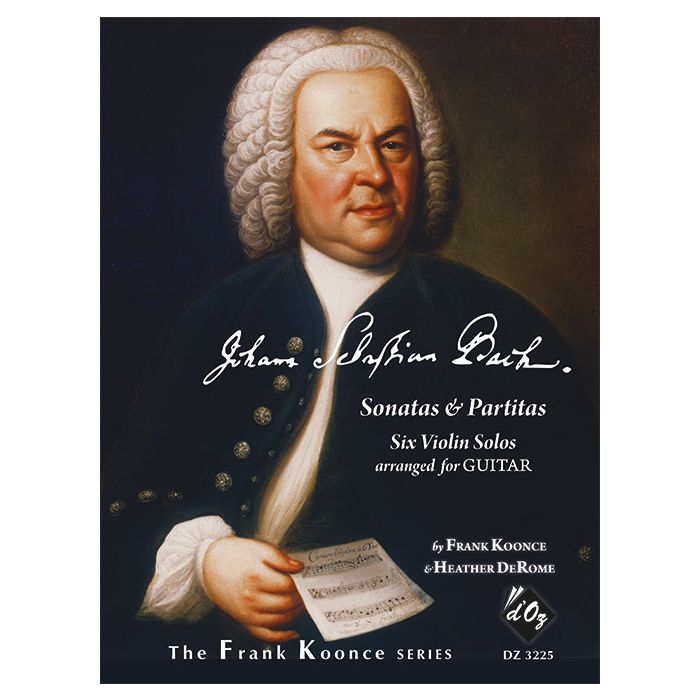
edited by Frank Koonce & Heather DeRome
Johann Sebastian Bach (1685–1750) completed his “Six Solos” in 1720, while serving as Kapellmeister at the court of Anhalt-Cöthen. Now usually referred to as the “Sonatas and Partitas,” the set comprises three of each. The Sonatas are written in the genre of a sonata da chiesa [church sonata], with a slow opening movement that functions as a prelude, followed by a fugue, then a moderately paced piece in a related key, and ending with a brilliant finale. The three Partitas exemplify the sonata da camera genre [chamber sonata] and consist of stylized dance movements.
According to Johann Friedrich Agricola (1720–1774), they were intended as studies “designed for learning to master the full resources of an instrument,... present[ing] all possible difficulties, to enable the student to acquire a firm control of them.” Carl Philipp Emanuel Bach (1714–1788) writes: “He understood to perfection the possibilities of all stringed instruments. This is evidenced by his solos for the violin and the violoncello without bass. One of the greatest violinists told me once that he had seen nothing more perfect for learning to be a good violinist, and could suggest nothing better to anyone eager to learn, than the said violin solos without bass.
| Featured Product | No |
|---|---|
| Arranger/Editor | Frank Koonce & Heather DeRome |
| Composer | BACH, JOHANN SEBASTIAN |
| Availability | Available |
| TAB/Notation | Music Notation Only |
| Level of Difficulty | 5 |
| Description | edited by Frank Koonce & Heather DeRome Johann Sebastian Bach (1685–1750) completed his “Six Solos” in 1720, while serving as Kapellmeister at the court of Anhalt-Cöthen. Now usually referred to as the “Sonatas and Partitas,” the set comprises three of each. The Sonatas are written in the genre of a sonata da chiesa [church sonata], with a slow opening movement that functions as a prelude, followed by a fugue, then a moderately paced piece in a related key, and ending with a brilliant finale. The three Partitas exemplify the sonata da camera genre [chamber sonata] and consist of stylized dance movements. According to Johann Friedrich Agricola (1720–1774), they were intended as studies “designed for learning to master the full resources of an instrument,... present[ing] all possible difficulties, to enable the student to acquire a firm control of them.” Carl Philipp Emanuel Bach (1714–1788) writes: “He understood to perfection the possibilities of all stringed instruments. This is evidenced by his solos for the violin and the violoncello without bass. One of the greatest violinists told me once that he had seen nothing more perfect for learning to be a good violinist, and could suggest nothing better to anyone eager to learn, than the said violin solos without bass. |