
Unaccompanied Django
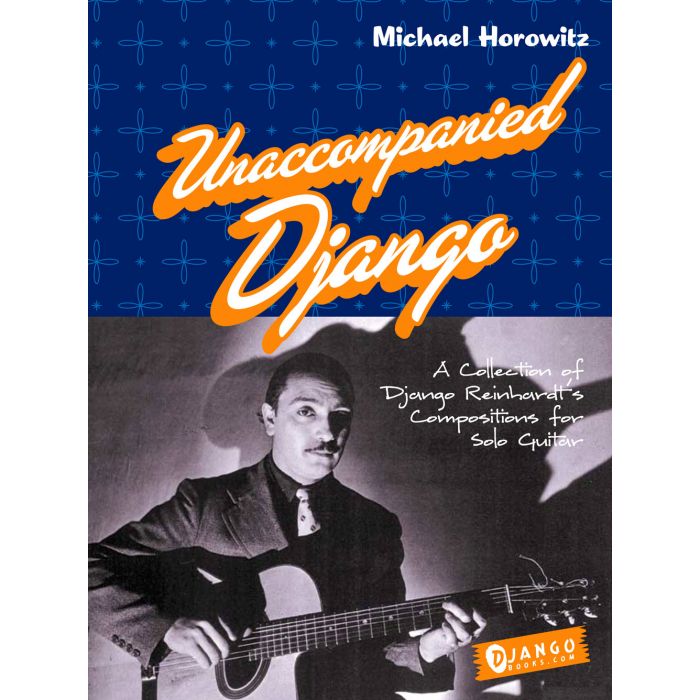
Finally, someone has given Django's solo pieces the attention and respect that they deserve. With Unaccompanied Django, Michael Horowitz has given guitarists a true gift; insight into the mind and compositional skills of the first true guitar hero, Django Reinhardt. Inside these pages you will find well-researched and skillful transcriptions that inspire the player, as well as the listener lucky enough to hear this music performed.
John Jorgenson, world-renowned session guitarist, former member of the Desert Rose Band, Hellecasters, and Elton John Band. He is currently touring and recording with the John Jorgenson Band and has been a leading proponent of Gypsy jazz in the U.S. for 20 years.
Michael S. Horowitz is at the forefront with his new company DjangoBooks.com. A Berklee grad with an M.A. in ethnomusicology, Horowitz received a Fulbright fellowship in 2002 to conduct his Ph.D. research among Dutch Sinti Gypsy jazz guitarists, including Fapy Lafertin, Martin Limberger, Jan Limberger, and Paulus Schafer. His masterpiece so far is Unaccompanied Django, a Herculean work of transcriptions and analyses of Django’s solo works that provide amazing insight into the master’s compositional thinking, his approaches to harmony and melody, and details the development of his solos. This book is not for the faint of heart in its scope and difficulty, but it is the single most enlightening book on Django’s playing yet published.
Michael Dregni, Vintage Guitar Magazine
Django Reinhardt’s musical fame has always rested upon his achievements as a single note soloist in a group context. However, this Gypsy guitar genius was also an excellent composer and performer for the unaccompanied solo guitar. So much so that he even earned the admiration of the father of modern classical guitar, Andres Segovia.Unaccompanied Django provides highly detailed transcriptions of 16 of Django’s solo guitar pieces such as Tears, Improvisation, and Nuages. These transcriptions, which are for both fingerstyle and pick-style guitar, are with out a doubt the best transcriptions ever done of Django’s music. Each piece includes both TAB and standard notation. To help you develop correct Gypsy jazz technique, Michael has included Gypsy style left hand fingerings and right hand picking suggestions. These suggestions are based on the field work he did among master Gypsy guitarists in Europe. In addition to Django’s music, there are two transcriptions of solo guitar music by Stochelo Rosenberg, the contemporary master of Gypsy jazz, and three Gypsy Etudes which are designed to teach harmonic and melodic devices used by contemporary Gypsy guitarists. Students of any level will benefit from this excellent collection which is easily the most thorough study of Gypsy jazz to date.
Clyde Holbrook, The Quarter Note – Dusty Strings Newsletter
For those of you who are currently working through Gypsy Picking, here’s another DjangoBooks.com release to fuel the fire to learn the authentic Gypsy style guitar.Unaccompanied Django examines the solo style of Jazz Manouche. From Django’s brilliant, often on-the-spot solos like Parfum and Naguine to Stochelo Rosenberg’s modern Stephanesque and the mellow and grooving Just Relax in addition to 14 other full transcriptions, Horowitz takes the lessons taught in Gypsy Picking and gives the player a melodic way to fully integrate them into their own playing. The transcriptions are outstanding, following Django’s original style – fingerings and all, while the Gypsy Etudes examine different stylistic traits common in Manouche solo guitar. Gypsy Picking set the standard for what a true method on Jazz Manouche should be and Unaccompanied Django raises that bar. Oh, and for all of you Gypsy jazz junkies out there who have broken the rewind button on your VCR’s in an attempt to learn Django’s glorious intro to J’Attendrai, that’s also included. Another killer DjangoBooks.com product!
Ted Gottsegen, Contributing Editor of Gypsy Jazz for Just Jazz Guitar
Unaccompanied Django, by Michael Horowitz, 176 pages, . An exhaustive study of Reinhardt’s often neglected solo compositions. Although best known for the blazing solos and intricate voicings he played with The Hot Club, Django was also capable of highly lyrical, and lovely, solo guitar playing. Here are the best examples, and how to play them, transcribed by an ethnomusicologist who plays this kind of guitar music for a living. Some solos by Stochelo Rosenberg are also transcribed and explained.
Richard Johnston, Gryphon Gazet
Those of you who’ve seen Gypsy Picking know how important his first book was to Gypsy jazz. It brought a new level of understanding to the right-hand picking technique.
His next book allows you to take these skills and apply them to unaccompanied pieces by Django as well as contemporary players like Stochelo, Angelo, Boulou, Fapy, and Bireli.
Working on soloing skills is a noble and satisfying undertaking. But, in my mind, studying unaccompanied pieces provides a different and possibly greater satisfaction — especially, if you are a lone player in your neighborhood.
Being able to pull off a Django piece by yourself allows you to dictate the emotional content and expression in a way independent of other’s influences. And there’s nothing like sitting on a deck or walking into a music store and being able to play a whole Django piece by yourself!
The pieces Michael’s picked provide you with more than this, however. They offer you an insight into Django’s head, helping you to form the vocabulary of his music and the mental blueprints he used to develop his Gypsy jazz soloing style.
There are 21 songs in the book. Enough material to keep most of us studying for a long time to come.
This book is the book that Michael worked on for years. Every piece has been carefully noted and tabbed. He has carefully identifed the proper Gypsy fingering patterns and pick strokes, something often missing with other tabs. The very process of memorizing these pieces brings insight and those “AH HA!” smiling moments of understanding.
Think of the first book Gypsy Picking as an “introduction” to the skills you need to appreciate the rest of your studies–much as RA Wilson’s Mask of the Illuminanti prepped you for the great Illuminantus trilogy, or Tolkien’s Hobbit opened the way to the Lord of the Rings. Think of Horowitz’ Unaccompanied Django as the beginning of your Gypsy jazz journey.
Archtop Eddy
Unaccompanied Django contains accurate transcriptions of Django Reinhardt's compositions for solo guitar. These wonderful and challenging pieces can benefit guitarists at any skill level.
Beginning students will find this book to be an excellent way to develop technique, learn authentic Gypsy-style chord voicings and melodic patterns, and develop a solo repertoire. Advanced students will benefit from the accurate notation and Gypsy-style fingering and picking suggestions for some of Django's most difficult phrases and chord voicings.
This book can also assist guitarists from a variety of stylistic backgrounds. Jazz guitarists who play in more contemporary styles will find the Gypsy approach to harmony an inventive and refreshing alternative to conventional jazz chord voicings. Fingerstyle guitarists will be pleased to find transcriptions for three of Django's fingerstyle guitar pieces (Naguine, Improvisation #2, and Tears). Approximately half of Django's unaccompanied guitar compositions were written in a Classical or Flamenco style and would therefore be excellent additions to the repertoire of guitarists playing in those genres. Django's unaccompanied guitar pieces sound great played fingerstyle despite the fact that most of them were originally played with a plectrum.
| Featured Product | No |
|---|---|
| Arranger/Editor | Michael Horowitz |
| Composer | REINHARDT, DJANGO |
| Availability | Available |
| TAB/Notation | Music Notation PLUS TAB |
| Additional Media | One Audio CD |
| Description | Unaccompanied Django contains accurate transcriptions of Django Reinhardt's compositions for solo guitar. These wonderful and challenging pieces can benefit guitarists at any skill level. Beginning students will find this book to be an excellent way to develop technique, learn authentic Gypsy-style chord voicings and melodic patterns, and develop a solo repertoire. Advanced students will benefit from the accurate notation and Gypsy-style fingering and picking suggestions for some of Django's most difficult phrases and chord voicings. This book can also assist guitarists from a variety of stylistic backgrounds. Jazz guitarists who play in more contemporary styles will find the Gypsy approach to harmony an inventive and refreshing alternative to conventional jazz chord voicings. Fingerstyle guitarists will be pleased to find transcriptions for three of Django's fingerstyle guitar pieces (Naguine, Improvisation #2, and Tears). Approximately half of Django's unaccompanied guitar compositions were written in a Classical or Flamenco style and would therefore be excellent additions to the repertoire of guitarists playing in those genres. Django's unaccompanied guitar pieces sound great played fingerstyle despite the fact that most of them were originally played with a plectrum. |